Red Hat Expands OpenShift Application Development Environment
Companies Mentioned

Why It Matters
The enhancements tighten security, simplify hybrid‑cloud operations, and accelerate enterprise consolidation of VMs, containers, and AI workloads on a single platform, reshaping the competitive landscape for cloud infrastructure providers.
Key Takeaways
- •OpenShift adds live VM migration, boosting hybrid cloud flexibility
- •Hardened container images and AI‑driven vulnerability scans enhance security
- •Red Hat Desktop with Podman enables local AI sandbox development
- •Karpenter autoscaling improves Kubernetes resource utilization across clouds
- •OpenShift VM count up 417%, driving platform consolidation for enterprises
Pulse Analysis
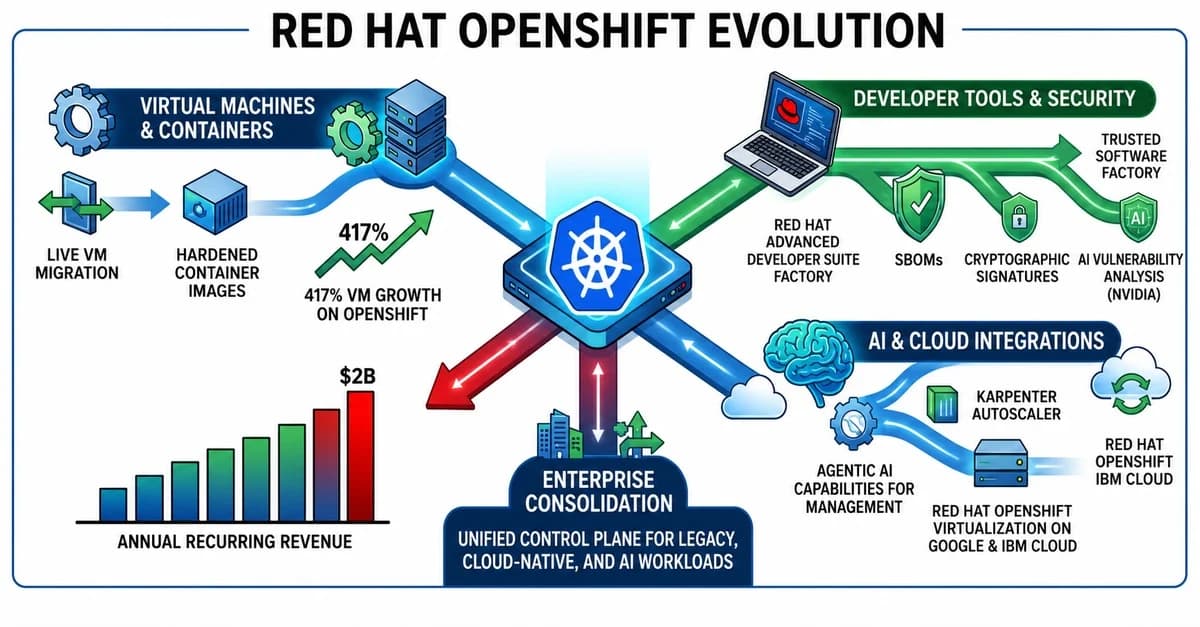
Red Hat’s latest OpenShift enhancements signal a decisive push toward a truly unified cloud‑native platform. By introducing live migration for virtual machines, the company removes a long‑standing barrier between traditional workloads and containerized services, allowing enterprises to shift resources without downtime. The preview of the Advanced Developer Suite, featuring a Trusted Software Factory, gives developers access to Red Hat’s internal CI/CD pipelines, trusted libraries, and hardened images—all of now generally available. Together, these capabilities position OpenShift as a single control plane for VMs, containers, and emerging AI agents.
Security has become a competitive differentiator, and Red Hat is betting on AI‑driven analysis to stay ahead. The new CI/CD platform embeds software‑bill‑of‑materials and cryptographic signatures, giving teams provenance for every artifact. Coupled with an NVIDIA‑powered vulnerability engine that reasons across codebases, the stack can automatically flag risky dependencies before they reach production. Hardened container images further reduce the attack surface, while Podman’s sandbox mode lets developers test AI agents locally. These layers of protection address both compliance mandates and the growing sophistication of supply‑chain threats.
The market response is already evident: OpenShift’s annual recurring revenue topped $2 billion and virtual‑machine deployments surged 417% in a year. Such growth reflects a broader industry shift toward consolidating legacy, cloud‑native, and AI workloads onto a Kubernetes‑based foundation. Features like Karpenter autoscaling and multi‑cloud virtualization on Google and IBM clouds improve utilization and lower operational costs. However, the rapid expansion also intensifies the talent crunch, as organizations must recruit engineers skilled in Kubernetes, security automation, and AI integration to fully realize the platform’s promise.
Red Hat Expands OpenShift Application Development Environment
Comments
Want to join the conversation?
Loading comments...