Amazon Haul Has Over 3,000 Sellers
•March 5, 2026
0
Why It Matters
Haul’s rapid seller adoption signals Amazon’s willingness to compete beyond its Prime‑fast‑shipping paradigm, reshaping the ultra‑cheap e‑commerce segment. The initiative forces incumbents to defend market share while exposing Amazon to tariff‑driven profitability risks.
Key Takeaways
- •3,287 sellers on Amazon Haul, mostly China‑based.
- •$2 billion GMV, far behind Temu and Shein.
- •Under‑$10 sellers generate ~$500k‑$1.3 m revenue each.
- •75% orders delivered within 11 days.
- •Amazon subsidizing growth despite tariff uncertainty.
Pulse Analysis
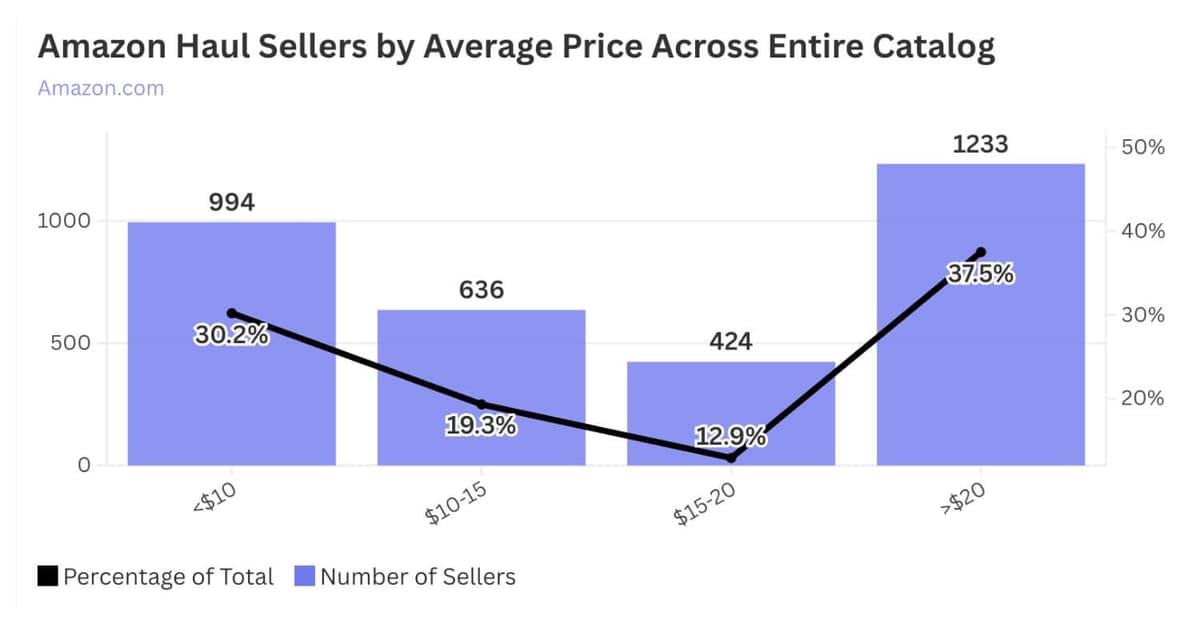
Amazon’s Haul program illustrates a strategic pivot toward the ultra‑low‑price, direct‑import model that has dominated fast‑growing Asian platforms. By aggregating over 3,000 sellers, primarily from China and Hong Kong, Amazon has built a catalog that now exceeds one million SKUs priced under $10. The move complements its broader marketplace by attracting price‑sensitive shoppers who value cost over speed, a demographic traditionally captured by Temu and Shein. Amazon’s aggressive discounting—sometimes up to 90% off—has accelerated seller onboarding and helped the platform reach an estimated $2 billion in annual gross merchandise volume, a modest share of the $48 billion U.S. direct‑from‑China market.
Seller economics within Haul reveal distinct revenue tiers tied to price points. Under‑$10 sellers average roughly $498,000 in annual sales, while those in the $10‑$15 and $15‑$20 brackets generate $943,000 and $1.3 million respectively. This segmentation underscores Amazon’s ability to monetize even the lowest‑margin listings through volume and cross‑selling opportunities across its broader ecosystem. Moreover, the platform’s 75% on‑time delivery rate within 11 days aligns with consumer expectations for cheap imports, reinforcing the “low‑and‑slow” value proposition that differentiates Haul from Amazon’s traditional Prime experience.
The long‑term viability of Haul hinges on a volatile regulatory backdrop. Recent shifts—such as the suspension of the de minimis exemption and the Supreme Court’s reversal of Liberation Day tariffs—have eroded the tariff arbitrage that once underpinned ultra‑cheap imports. Amazon appears prepared to absorb short‑term losses, betting that scale and brand trust will eventually offset subsidy costs. However, as competitors like Temu pivot toward localized fulfillment, Amazon must balance its low‑price ambition with profitability pressures, making Haul’s evolution a litmus test for the retailer’s adaptability in a rapidly changing e‑commerce landscape.
Amazon Haul Has Over 3,000 Sellers
0
Comments
Want to join the conversation?
Loading comments...