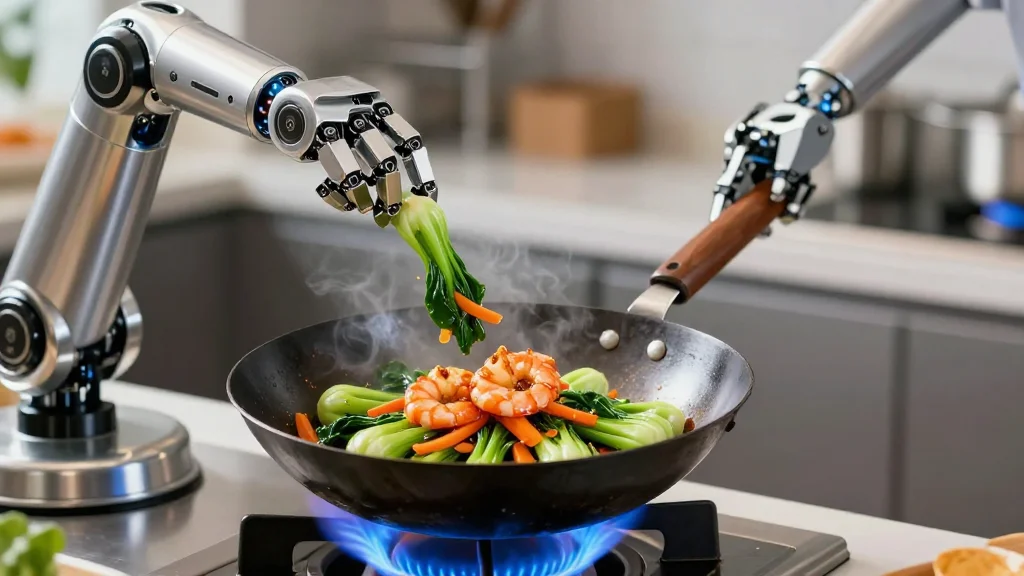
Robotic Kitchen Opens at Frankfurt’s Vipho, Automating Stir‑Fry and Grilling

Why It Matters
The Vipho robot kitchen illustrates how automation can directly address Europe’s acute hospitality labor shortage, offering a scalable model for restaurants that rely heavily on delivery revenue. By reducing the physical burden on kitchen staff and shrinking the spatial footprint of production, the technology could lower operating costs and make the sector more resilient to future shocks, such as pandemics or energy price spikes. Moreover, the hybrid human‑robot workflow preserves culinary quality while delivering the speed demanded by modern consumers, potentially redefining the competitive landscape for mid‑tier dining establishments. If successful, the model may prompt policymakers to reconsider regulations around food safety and labor in automated environments, while investors could see a new asset class emerge in the form of “robotic dark kitchens.” The ripple effects could extend to supply chains, real‑estate markets, and culinary education, as the skill set required for kitchen work evolves from manual cooking to system oversight and robotics maintenance.
Key Takeaways
- •Vipho’s new kitchen uses a Goodbytz robot to automatically stir‑fry and grill for delivery orders.
- •Co‑owners Thu Dinh and Hung Quach say the robot handles repetitive tasks while chefs manage prep and quality.
- •The robot occupies only 10‑20 sqm, eliminating the need for traditional exhaust systems and reducing equipment costs.
- •Labor shortage and pandemic‑driven delivery growth were key drivers behind the automation decision.
- •Founder Tim Plasse of F&B Heroes predicts broader adoption of robotic kitchens across Europe.
Pulse Analysis
Automation in foodservice is moving from novelty to necessity, and Vipho’s deployment is a concrete illustration of that transition. Historically, the restaurant industry has resisted large‑scale mechanization because of the perceived loss of culinary artistry. However, the pandemic forced many operators to prioritize speed and consistency over the traditional chef‑centric model. Vipho’s hybrid approach—keeping human chefs in the loop for prep and quality while delegating repetitive cooking to a robot—offers a compromise that preserves the brand’s culinary identity while reaping efficiency gains.
From a market perspective, the robot’s compact footprint could unlock premium real‑estate in dense urban districts where rent is a major cost driver. Restaurants can now consider locating delivery‑only hubs in neighborhoods previously unaffordable for full‑scale kitchens. This spatial flexibility may also spur competition among delivery platforms, as they vie for partnerships with tech‑enabled kitchens that can guarantee rapid fulfillment.
Looking forward, the success of Vipho’s robot kitchen will hinge on consumer acceptance of robot‑cooked food and the ability of operators to maintain consistent taste across high‑volume output. If the model scales, we could see a bifurcation in the industry: a premium segment that continues to emphasize handcrafted experiences, and a mass‑market segment that leans heavily on automation to meet price and speed expectations. Investors and policymakers should watch how labor unions, food safety regulators, and technology providers negotiate this emerging ecosystem.
Robotic Kitchen Opens at Frankfurt’s Vipho, Automating Stir‑Fry and Grilling
Comments
Want to join the conversation?
Loading comments...