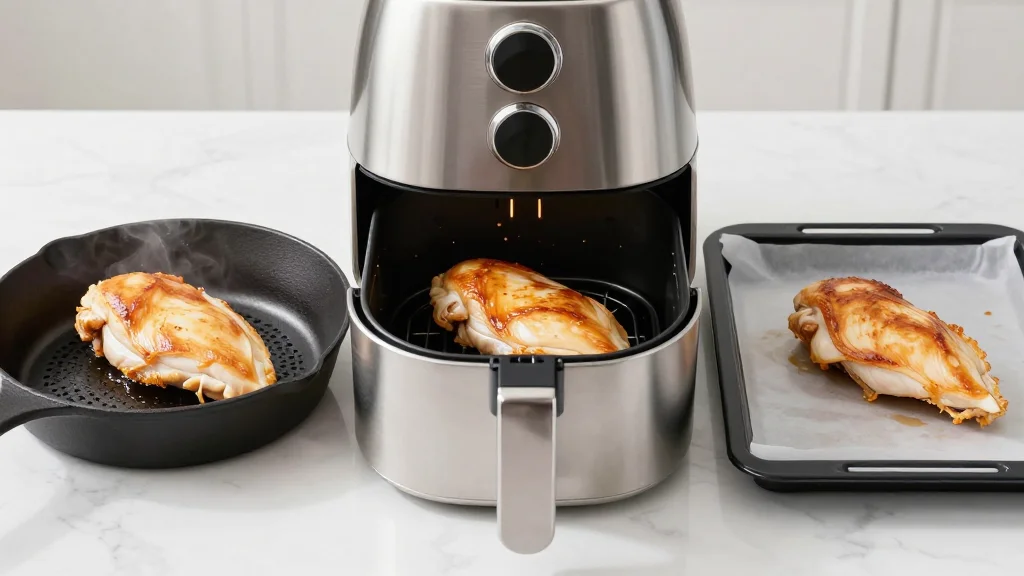
This Everyday Way to Cook Chicken Breast Beats Your Oven and Air Fryer – but Most Brits Still Skip It
Why It Matters
Understanding which cooking technique maximizes juiciness helps consumers reduce food waste and energy costs, especially as household energy prices rise. The insights also guide appliance manufacturers and recipe developers toward features that prioritize flavor and efficiency.
Key Takeaways
- •Pan-frying yields juiciest chicken with a golden crust.
- •Air fryer offers quick, consistent results for 1‑2 servings.
- •Oven cooks larger batches but produces paler, milder meat.
- •Brining 1 L water with 60 g salt improves moisture retention.
- •Resting chicken 5‑10 minutes prevents juice loss after cooking.
Pulse Analysis
Energy‑price pressures and crowded kitchen counters have turned the humble chicken breast into a test of efficiency and flavor. Home cooks increasingly rely on quick‑cook appliances, yet the choice of method can dramatically affect both taste and utility bills. By standardising seasoning, temperature, and meat size, Angela Patrone’s experiment offers a data‑driven look at how pan‑frying, air‑frying, and fan‑oven baking stack up against each other, providing a practical benchmark for the everyday cook.
The pan‑fry approach leverages high‑heat searing to create a caramelised crust that locks in juices, a process known as the Maillard reaction. A brief lid‑covered steam phase then finishes cooking without drying the interior, delivering the most succulent bite. Air fryers, with circulating hot air, replicate a convection environment that yields evenly cooked, moist meat while requiring minimal supervision and cleanup—ideal for single‑serve meals. Fan ovens, though slower and producing a paler exterior, excel when cooking multiple breasts simultaneously, making them suitable for batch‑prep meals like salads or casseroles.
Beyond appliance choice, the study underscores three low‑cost techniques that boost results: a quick 30‑minute brine (1 L water with 60 g salt) to enhance moisture retention, flattening breasts for uniform thickness, and resting the cooked meat for five to ten minutes to let juices redistribute. These habits not only improve flavor but also reduce waste, aligning with sustainability goals. For food brands and kitchen‑tech designers, emphasizing features that facilitate searing, steam, and easy resting could capture a market eager for both convenience and culinary quality.
This everyday way to cook chicken breast beats your oven and air fryer – but most Brits still skip it
Comments
Want to join the conversation?
Loading comments...