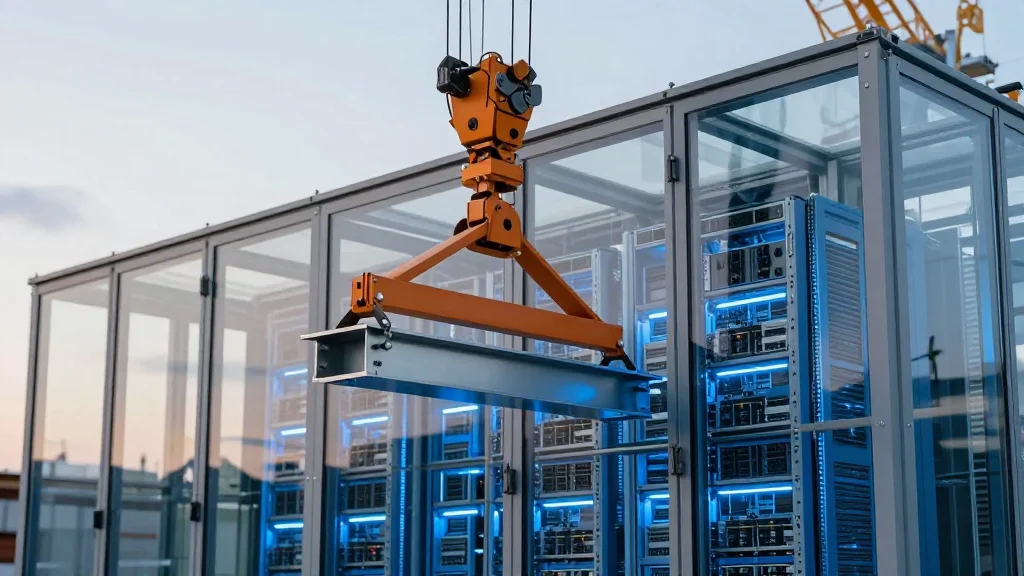
Amazon's 'Titus' Program Cuts AI Data‑Center Build Time to Under 35 Weeks

Companies Mentioned
Why It Matters
Titus directly addresses two critical bottlenecks in AI cloud services: the time required to bring new compute capacity online and the energy cost of cooling ever‑more power‑dense hardware. By shortening construction cycles to under 35 weeks, AWS can respond to spikes in demand faster than rivals, reducing the risk of capacity shortages that could drive customers to alternative providers. The 15% cooling‑power reduction also aligns with broader corporate sustainability goals, helping Amazon meet its emissions targets while keeping operating expenses in check. The program’s emphasis on liquid cooling and higher rack power density signals a shift in data‑center design philosophy across the industry. As AI workloads continue to outpace the cooling capabilities of traditional air‑based systems, other cloud providers will likely be forced to adopt similar technologies or risk falling behind. Titus therefore sets a new benchmark for what enterprise customers can expect in terms of speed, efficiency, and scalability from their cloud partners.
Key Takeaways
- •Titus aims to cut AI‑data‑center build time to under 35 weeks, versus the industry average of 50‑plus weeks.
- •Per‑site compute capacity will rise from ~58 MW to ~68 MW, adding roughly 10 MW of AI‑ready power.
- •Advanced liquid‑cooling (IRHX) is projected to lower cooling power consumption by 15%.
- •The initiative is part of Amazon’s $200 billion 2026 capital‑expenditure plan, heavily weighted toward AI infrastructure.
- •Analyst Reyk Knuhtsen calls the move an "important strategy push" as cloud rivals race to meet AI demand.
Pulse Analysis
Amazon’s Titus program is more than a construction sprint; it is a strategic lever to lock in AI‑centric revenue streams that are rapidly becoming the most profitable segment of cloud services. Historically, cloud providers have competed on price and breadth of services, but the AI wave is shifting the battleground to physical infrastructure. By engineering a faster, higher‑density, and more energy‑efficient data‑center model, AWS can lower the total cost of ownership for customers running large language models and other compute‑intensive workloads. This cost advantage could translate into higher margins for Amazon, especially as AI workloads command premium pricing.
The liquid‑cooling focus also positions AWS ahead of the sustainability curve. Data‑center energy consumption accounts for a growing share of global electricity use, and regulators are tightening emissions standards. A 15% reduction in cooling power not only cuts operational expenses but also helps Amazon meet its own climate commitments, a factor increasingly important to enterprise buyers. Competitors will need to match or exceed these efficiencies to stay competitive, potentially sparking an industry‑wide wave of modular, liquid‑cooled designs.
Looking forward, the success of Titus will hinge on execution at scale. If AWS can consistently deliver sub‑35‑week builds across multiple regions, it will create a virtuous cycle: faster rollout attracts more AI customers, which fuels further investment in the program, reinforcing Amazon’s market dominance. Conversely, any delays or performance shortfalls could erode the perceived advantage and give rivals an opening. The next 12‑18 months will therefore be a critical test of whether engineering innovation can translate into sustained market leadership in the AI‑driven cloud economy.
Amazon's 'Titus' Program Cuts AI Data‑Center Build Time to Under 35 Weeks
Comments
Want to join the conversation?
Loading comments...