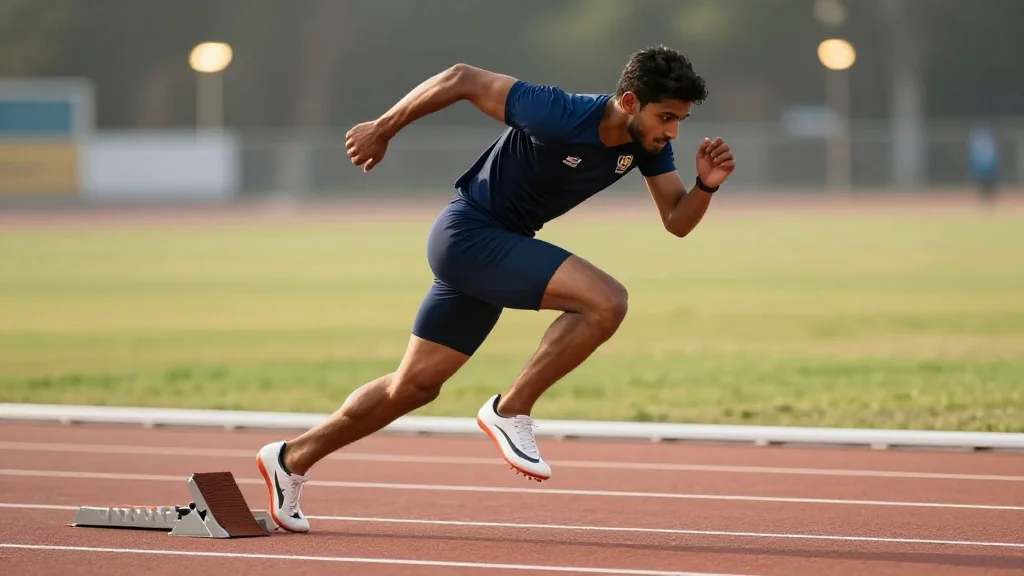
Indian Navy Petty Officer Gurindervir Singh Breaks 100m Record with 10.09‑Second Sprint

Why It Matters
Singh’s record does more than rewrite the books; it redefines what Indian athletes believe is achievable in pure speed events. By breaking a long‑standing barrier, he provides a tangible benchmark for upcoming sprinters, encouraging them to adopt rigorous, militarily inspired training models that emphasize discipline, resilience, and systematic support. The achievement also showcases how public‑private partnerships—exemplified by the Reliance Foundation’s involvement—can accelerate talent development in a country where infrastructure gaps have historically hampered elite performance. Beyond the track, Singh’s narrative reinforces a broader cultural message about motivation: setbacks, whether health‑related or institutional, can become catalysts for growth when paired with unwavering belief and structured guidance. As schools, sports clubs, and the armed forces cite his story, it may inspire a wave of youth to pursue athletics with a renewed sense of purpose, potentially expanding India’s talent pool for future international competitions.
Key Takeaways
- •Gurindervir Singh ran 10.09 seconds, the fastest 100 m time ever recorded by an Indian.
- •He became the first Indian male sprinter to break the 10.10‑second barrier.
- •The performance met the Commonwealth Games qualifying standard of 10.16 seconds.
- •Singh’s success is backed by the Indian Navy and the Reliance Foundation’s high‑performance program.
- •His story is being used to motivate young athletes and promote disciplined training across India.
Pulse Analysis
Singh’s breakthrough illustrates a convergence of personal grit and institutional scaffolding that is reshaping Indian sport. Historically, Indian sprinting has suffered from fragmented coaching, limited facilities, and a cultural bias toward endurance events. The Navy’s involvement provides a disciplined environment akin to elite military training, while the Reliance Foundation injects modern sports science and financial resources. This hybrid model could become a template for other disciplines, where the state supplies structure and the private sector supplies technology and expertise.
From a motivation theory perspective, Singh’s journey aligns with the concept of ‘self‑determination’—the athlete’s intrinsic drive, bolstered by external validation from coaches and national bodies, fuels sustained effort. His recovery from a serious illness and the skepticism he faced underscore the role of adversity in strengthening resolve. As more athletes witness a compatriot shatter a perceived ceiling, the collective efficacy of Indian sprinting is likely to rise, creating a virtuous cycle of higher expectations and better performance.
Looking forward, the key question is scalability. Can the Navy‑Reliance partnership be replicated across other regions and sports? If the answer is yes, India could see a rapid uplift in its medal prospects at upcoming Asian, Commonwealth, and Olympic Games. Singh’s next test on the world stage will be a litmus test for whether the motivation sparked at Ranchi can translate into global competitiveness, potentially redefining India’s athletic identity for the next decade.
Indian Navy Petty Officer Gurindervir Singh Breaks 100m Record with 10.09‑Second Sprint
Comments
Want to join the conversation?
Loading comments...