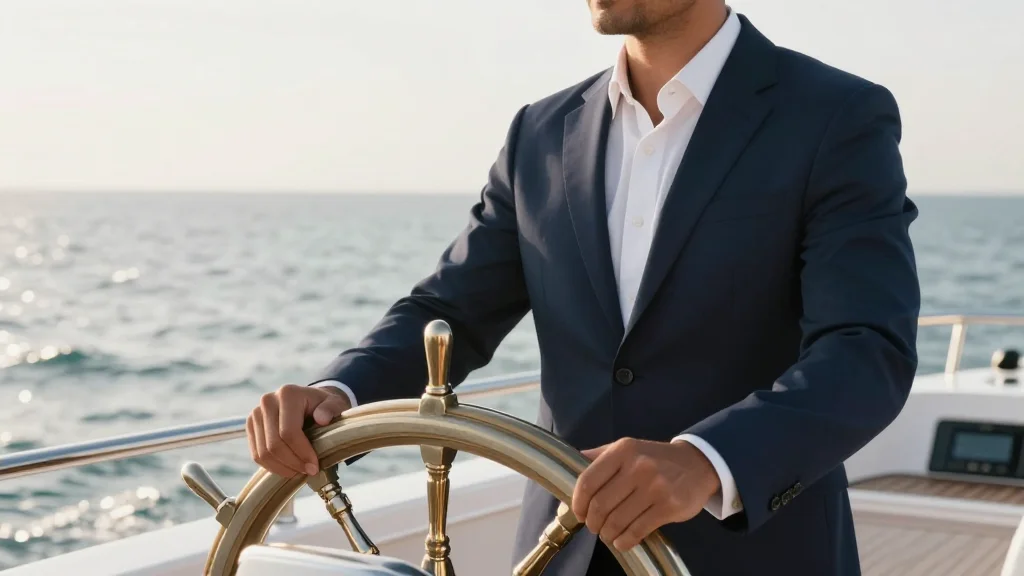
Yacht Captain Whitney Reiter Credits Discipline for Global Yachting Success

Why It Matters
Reiter’s emphasis on disciplined routines offers a tangible case study for motivation professionals seeking evidence‑based practices. By linking physical habit formation to decision‑making clarity, he illustrates how personal discipline can cascade into organizational performance. In an era where remote work and fragmented teams challenge traditional leadership, his hands‑on, structured approach provides a replicable model for building trust and accountability. Moreover, the yachting sector’s high‑stakes environment serves as a microcosm for other industries—aviation, logistics, and offshore energy—where safety, precision, and crew cohesion are non‑negotiable. Reiter’s success suggests that motivation strategies rooted in daily habit formation and collective physical activity can yield measurable operational benefits, prompting executives to reconsider wellness programs as strategic assets rather than peripheral perks.
Key Takeaways
- •Whitney Reiter, a 1600/3000‑ton All Oceans Master, attributes his global yachting influence to disciplined leadership.
- •He begins each day with early‑morning physical training, citing it as a source of mental clarity.
- •Reiter integrates crew workouts and pickleball to build trust and improve performance.
- •His proactive management anticipates regulatory, weather, and logistical challenges across five major regions.
- •A mentorship program based on his discipline model is planned for rollout in late 2026.
Pulse Analysis
Reiter’s story arrives at a moment when motivation literature is shifting from abstract inspiration to concrete habit engineering. His daily training routine mirrors the ‘tiny habits’ framework popularized by behavior‑science researchers, suggesting that even in high‑risk environments, micro‑level discipline can produce macro‑level outcomes. By publicly linking physical consistency to decision‑making speed, Reiter validates a hypothesis that many corporate wellness programs have only hinted at: that disciplined bodies foster disciplined minds.
Historically, maritime leadership has relied on hierarchical command structures, but Reiter’s emphasis on shared physical activity signals a cultural pivot toward collaborative resilience. This mirrors trends in elite sports teams, where joint conditioning sessions are used to cement trust. If his upcoming mentorship program can codify these practices, the yachting industry could see a new standard where leadership development includes mandatory fitness and habit‑tracking components, potentially reshaping certification requirements.
Looking forward, the scalability of Reiter’s model will be the litmus test. While his personal charisma and decades of experience are hard to replicate, the underlying principles—structured routines, proactive risk management, and team‑wide physical engagement—are transferable. Companies across sectors may begin to adopt similar frameworks, positioning disciplined habit formation as a core competency for leaders tasked with navigating increasingly complex operational landscapes.
Yacht Captain Whitney Reiter Credits Discipline for Global Yachting Success
Comments
Want to join the conversation?
Loading comments...