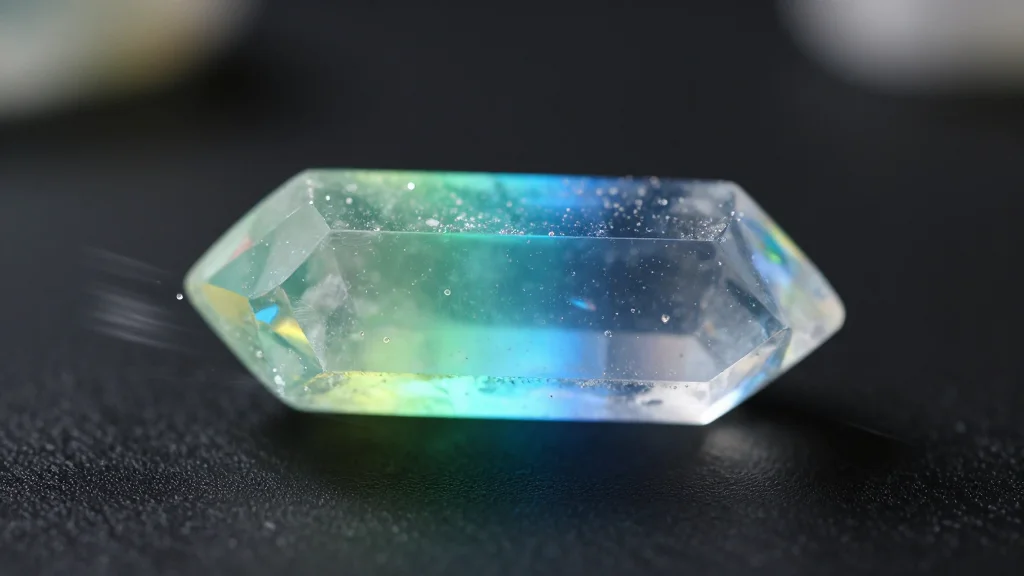
A Crystal that Changes Fluorescence Color and Moves when Heated
Key Takeaways
- •Nonporous crystal releases solvent via heat‑induced molecular rotations
- •Fluorescence shifts blue→green→yellow during two‑step transformation
- •Asymmetric bubble formation propels crystal forward under microscope
- •Gear‑like rotations create temporary diffusion pathways in solid lattice
- •Findings suggest new design route for responsive solid‑state devices
Pulse Analysis
Thermochromic fluorescence in solid materials has long been a niche curiosity, typically limited to polymers or porous frameworks that change color with temperature. The NTU team’s pentiptycene‑derived crystal breaks this convention by delivering a vivid blue‑green‑yellow emission sequence entirely within a dense, nonporous lattice. The key lies in “molecular gear” rotations that temporarily carve diffusion pathways, allowing trapped dichloromethane molecules to escape. This internal reconfiguration not only alters the electronic environment—producing distinct fluorescence bands—but also showcases a novel mechanism for controlled, reversible color change in truly solid-state systems.
Beyond optics, the crystal exhibits autonomous motion driven by bubble formation. As solvent exits the lattice, it nucleates microscopic bubbles on one side of the crystal, creating an imbalance of surface tension that thrusts the particle forward. This bubble‑propelled locomotion mirrors concepts seen in catalytic micromotors but emerges from a purely solid matrix without external catalysts. The ability to couple a thermally triggered chemical release with directional propulsion suggests new designs for micro‑robots that can navigate confined environments using heat as the sole stimulus.
The broader implications span smart coatings, temperature‑sensing devices, and targeted delivery platforms. A material that simultaneously signals temperature changes through color and moves toward or away from a stimulus could enable self‑adjusting optical filters or drug carriers that release payloads upon heating. However, scaling the phenomenon and controlling motion directionality remain challenges. Future research will likely explore alternative solvent‑guest systems, programmable crystal geometries, and integration with electronic interfaces, positioning these responsive crystals at the frontier of adaptive solid‑state technology.
A crystal that changes fluorescence color and moves when heated
Comments
Want to join the conversation?