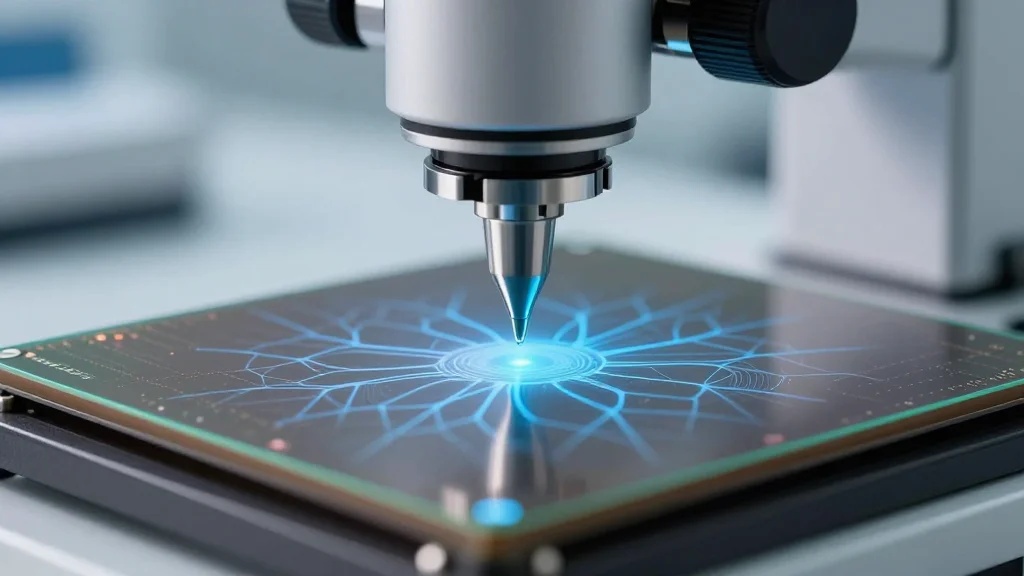
AI-Guided AFM Analyzes Nanostructures without Human Intervention
Key Takeaways
- •AI automates probe selection and scan‑path planning in AFM
- •Deep‑learning models denoise and super‑resolve nanoscale images
- •Reinforcement learning enables real‑time adjustment of scan speed and force
- •Autonomous AFM speeds drug discovery and cancer diagnostic research
- •Review provides roadmap for integrating AI across all AFM stages
Pulse Analysis
Atomic force microscopy has long been the workhorse for visualizing biomolecules at the nanometer scale, yet its adoption in high‑throughput biomedical workflows has been hampered by slow scan rates, manual image interpretation, and variability between operators. The new review authored by Professor Lee Jeong‑hoon’s team at Korea University, together with collaborators from Harvard‑affiliated MGH and Seoul’s biomedical engineering community, maps a comprehensive AI‑driven architecture that tackles each bottleneck. By embedding machine‑learning modules directly into the instrument’s control loop, the platform promises to shift AFM from a specialist’s tool to a scalable analytical engine.
The authors detail how convolutional neural networks can classify molecular features, while generative adversarial networks restore degraded scans and variational autoencoders extract compact representations for rapid comparison. Graph neural networks add relational insight, enabling the system to recognize complex protein assemblies. A reinforcement‑learning controller dynamically tunes probe force, scan speed, and resolution in response to real‑time feedback, effectively learning optimal imaging strategies without human input. This multi‑layered AI stack not only accelerates data acquisition but also standardizes output, delivering reproducible, super‑resolved 3‑D reconstructions that were previously unattainable.
For industries ranging from materials science to pharmaceutical development, the ability to automate nanoscale characterization could compress discovery timelines dramatically. Faster, higher‑quality AFM data supports more reliable structure‑activity relationships, informing drug‑target validation and early‑stage cancer biomarker detection. Moreover, the review’s roadmap—covering probe optimization, scan‑path planning, image enhancement, and autonomous decision‑making—offers a clear blueprint for vendors to embed AI modules into next‑generation microscopes. As proprietary algorithms mature, we can expect a new market of AI‑augmented AFM systems that deliver laboratory‑grade precision with the throughput required for commercial R&D pipelines.
AI-guided AFM analyzes nanostructures without human intervention
Comments
Want to join the conversation?