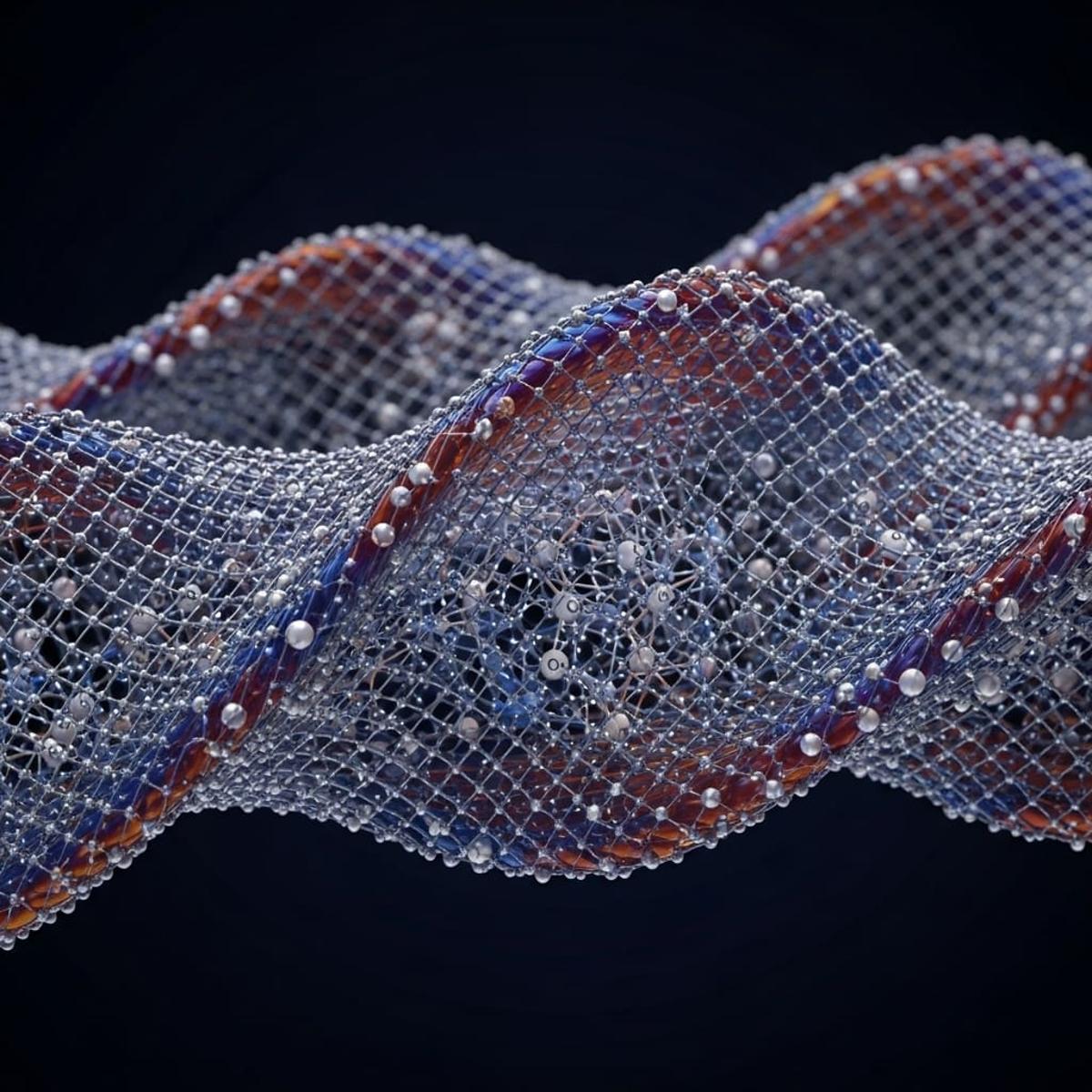
Atomic Coherence Achieved in Twisted NaNbO3 Membranes Via Controlled Oxygen Treatment
•January 30, 2026
0
Why It Matters
The breakthrough overcomes the long‑standing barrier of interfacial disorder in oxide twistronics, allowing designers to harness emergent ferroic and electronic phenomena at scale. It provides a practical route to engineer functional heterostructures without sacrificing volatile elements.
Key Takeaways
- •Oxygen annealing creates atomically bonded NaNbO3 interface.
- •Shear strain ~0.9% confined to top membrane only.
- •Roughness drops from 960 pm to 186 pm after treatment.
- •Asymmetric strain yields long‑range electromechanical coupling.
- •Approach may extend to other volatile‑element oxide systems.
Pulse Analysis
Twistronics has reshaped expectations for layered materials, yet oxide systems have lagged because interfacial amorphous layers disrupt the delicate moiré interactions that drive novel electronic states. Traditional high‑temperature anneals often volatilize alkali constituents such as sodium, leaving behind carbon‑rich residues that act as mechanical decouplers. By leveraging a low‑temperature, oxygen‑rich environment, the NaNbO₃ membranes avoid elemental loss while chemically bonding the two twisted layers, effectively turning a previously disordered interface into a crystalline bridge.
The authors employed atomic‑resolution imaging and peak‑pairs strain analysis to quantify the resulting strain landscape. The top membrane accommodates a shear strain of roughly 0.9 % while the bottom remains nearly unstrained, a direct consequence of the reconstructed interface acting as a one‑way strain conduit. This asymmetric strain distribution not only reduces surface roughness by more than a factor of five but also activates long‑range electromechanical coupling—a prerequisite for tunable ferroic responses and potential quantum‑phase engineering in oxide moiré lattices.
Beyond the immediate scientific insight, the methodology offers a scalable template for other volatile‑element oxides, where preserving stoichiometry during processing is critical. Industries focused on next‑generation sensors, non‑volatile memory, and adaptive electronics could exploit these strain‑engineered superlattices to achieve higher performance and new functionalities. Future work will likely explore device integration, temperature‑dependent behavior, and the extension of oxidative annealing to complex heterostructures, positioning chemically coherent twisted oxides as a cornerstone of emerging electronic platforms.
Atomic Coherence Achieved in Twisted NaNbO3 Membranes Via Controlled Oxygen Treatment
0
Comments
Want to join the conversation?
Loading comments...