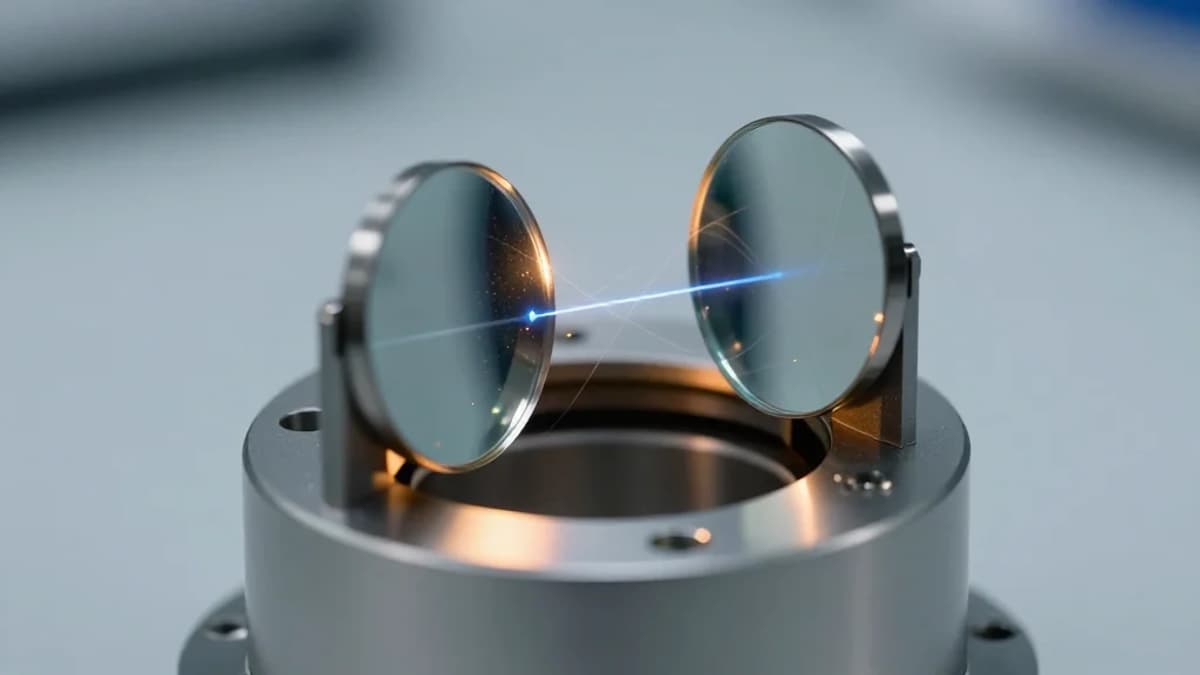
Double-Cycle Circular Cavity Raman System Enables Stable, High-Sensitivity Gas Detection
•January 21, 2026
0
Why It Matters
The breakthrough removes a key barrier to deploying Raman‑based gas sensors in real‑world environments, enabling more reliable trace‑gas monitoring for environmental and industrial applications.
Key Takeaways
- •Double-cycle cavity doubles optical path length.
- •Design tolerates misalignment, stable in field.
- •Enhances Raman signal for trace gas detection.
- •Detects CO2, H2O, O2 isotopes at ambient conditions.
- •Enables practical Raman sensors for environmental monitoring.
Pulse Analysis
Raman spectroscopy is prized for its molecular fingerprinting ability, yet its inherently weak scattering often limits practical use, especially for trace‑gas analysis. Traditional cavity‑enhanced approaches can amplify signals but demand sub‑micron alignment, making them fragile in field deployments. The new double‑cycle circular confocal cavity sidesteps these constraints by leveraging a ring of spherical mirrors that naturally refocus the beam, delivering a high‑finesse path that remains stable despite lateral or longitudinal offsets. This architecture not only simplifies setup but also opens the door for portable Raman instruments.
The core innovation lies in the double‑cycle configuration: a retro‑reflector sends the laser back through the same optical path, effectively doubling the interaction length without adding extra components. This results in a near‑linear increase in Raman photon collection, translating to measurable signal gains for gases present at parts‑per‑million levels. Moreover, the confocal geometry accommodates beams with larger divergence angles, reducing the need for precision collimation optics. Experimental validation showed clear spectral lines for CO₂, H₂O, and various O₂ isotopes, confirming that the system can operate under standard atmospheric pressure and temperature.
From a market perspective, the technology addresses a longstanding gap in environmental monitoring, industrial safety, and process control where reliable, real‑time trace‑gas detection is critical. Its tolerance to misalignment and compact footprint make it attractive for integration into drones, remote stations, or on‑site inspection tools. As regulatory pressures mount for emissions reporting and air‑quality compliance, manufacturers that adopt this cavity‑enhanced Raman platform could gain a competitive edge. Future work may focus on scaling the cavity size, extending wavelength coverage, and automating calibration to further broaden commercial viability.
Double-cycle circular cavity Raman system enables stable, high-sensitivity gas detection
0
Comments
Want to join the conversation?
Loading comments...