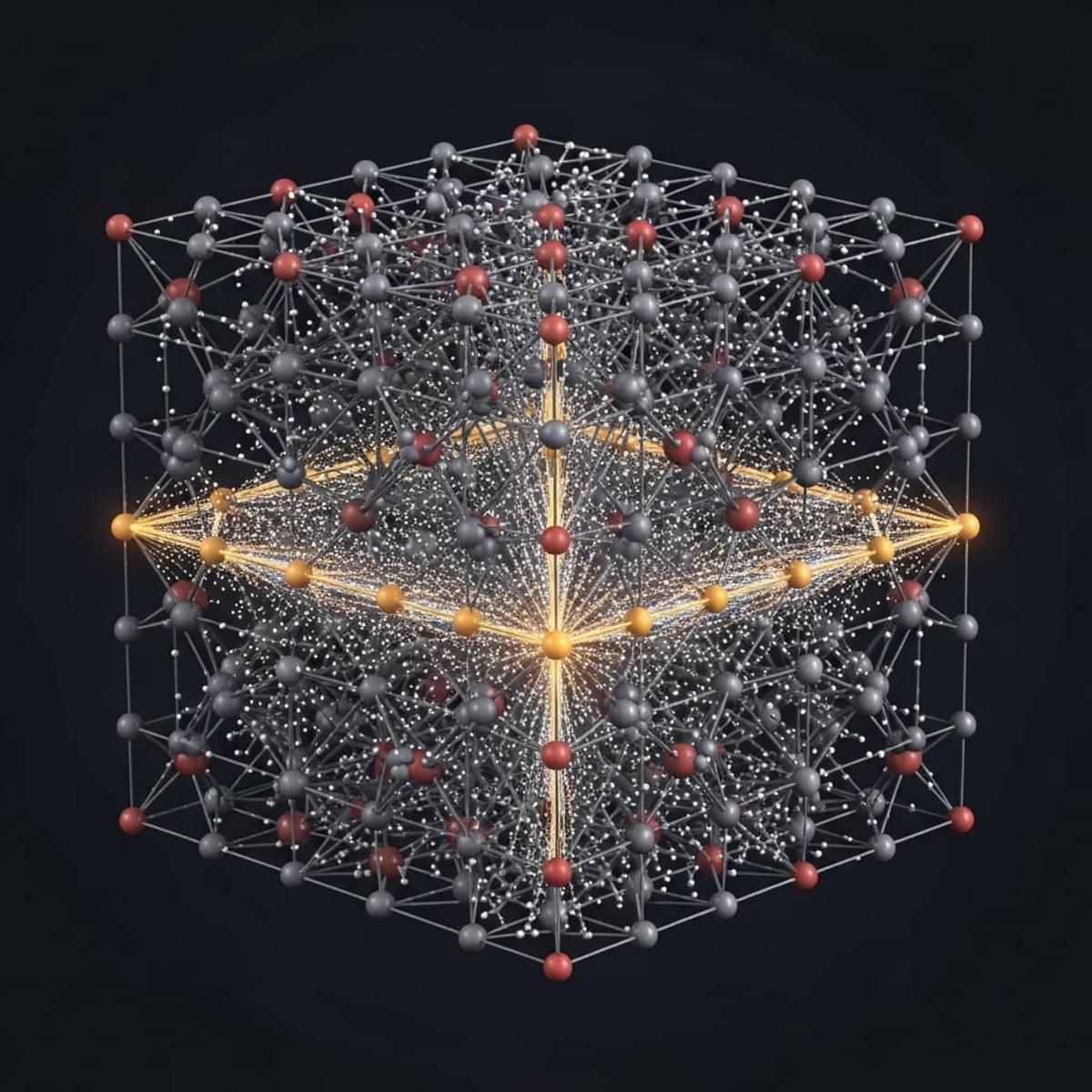
Electrons Meet Ferroelastic Walls in Strontium Titanate, Advancing Oxide Electronics
•January 21, 2026
0
Why It Matters
By revealing how domain‑wall polarity and strain dictate electron behavior, the study provides a lever to engineer functional properties in correlated oxides, accelerating device innovation and fundamental understanding of superconductivity mechanisms.
Key Takeaways
- •Ferroelastic walls host polar order influencing electrons
- •Glass-like relaxations and memory observed at low temperatures
- •Electric fields induce twin‑wall motion detectable via optical imaging
- •Domain walls channel currents in LaAlO₃/SrTiO₃ heterostructures
- •Findings enable engineering oxide electronics through domain‑wall control
Pulse Analysis
Strontium titanate has long served as a benchmark material for solid‑state research, prized for its high dielectric constant, quantum paraelectric behavior, and a well‑characterized antiferrodistortive transition near 105 K. Beyond its bulk properties, the material develops a dense network of ferroelastic twin domains whose walls were traditionally viewed as static structural imperfections. Recent investigations, however, reveal that these walls acquire a polar character and host strain‑mediated fluctuations, creating a nanoscale landscape where electrons experience locally varying potentials. This nuanced view aligns SrTiO₃ with a broader class of correlated oxides where local order can dominate macroscopic transport.
Advanced spectroscopic and imaging tools were pivotal in uncovering the dynamic nature of these walls. Resonant piezospectroscopy identified low‑frequency mechanical resonances that softened with temperature, indicating intrinsic wall mobility. Complementary electric‑field‑dependent optical imaging directly captured twin‑wall displacement at temperatures below 40 K, while scanning SQUID microscopy mapped stripe‑like current pathways aligned with specific domain orientations. A carbon‑nanotube‑based single‑electron transistor further visualized electrostatic modulation at the walls, confirming that polar fields persist even in electron‑doped, metallic SrTiO₃. Together, these techniques demonstrate that domain walls can attract charge carriers, produce glass‑like electron relaxations, and retain memory of prior electric stimuli.
The implications for oxide electronics are profound. By harnessing wall‑induced polarity and strain, engineers can design devices where charge flow is guided, switched, or stored at the nanoscale without the need for extrinsic patterning. Moreover, the persistence of polar order in a metallic matrix offers a fresh angle on the enigmatic superconductivity of SrTiO₃, suggesting that domain‑wall physics may play a role in pairing mechanisms. Future research will likely explore controlled domain‑wall engineering, integration with heterostructures, and the translation of these phenomena into functional components such as non‑volatile memory or quantum‑coherent elements. The study thus establishes ferroelastic walls as a versatile tool for next‑generation oxide‑based technologies.
Electrons Meet Ferroelastic Walls in Strontium Titanate, Advancing Oxide Electronics
0
Comments
Want to join the conversation?
Loading comments...