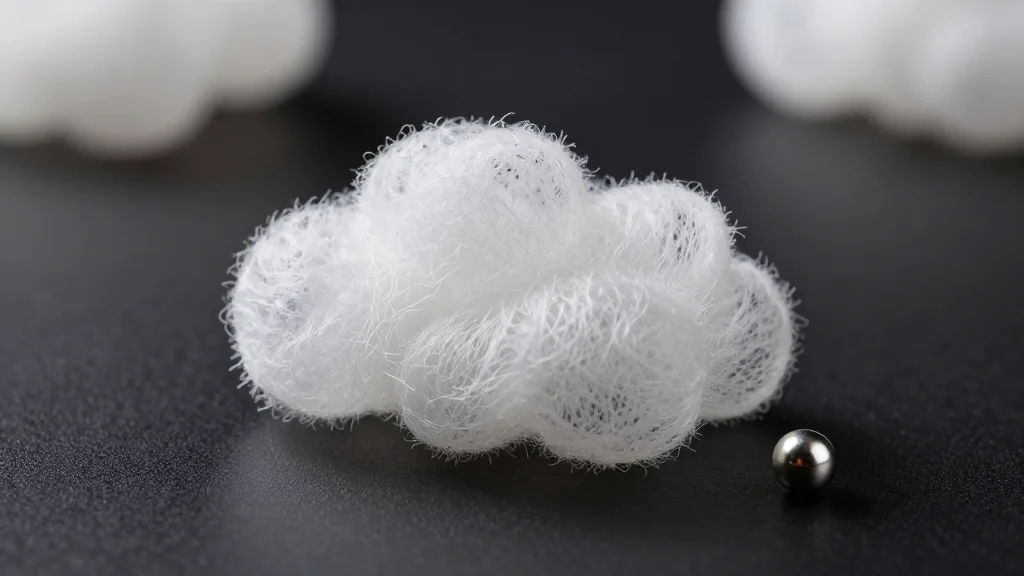
Fused Nanofiber Aerogel for Deployable Spacecraft Insulation
Key Takeaways
- •BC‑PVSQ aerogel retains 98.8% porosity with 16.1 mg cm⁻³ density
- •Thermal conductivity stays at 27 mW m⁻¹ K⁻¹ despite mechanical reinforcement
- •Recovers after 99% compressive strain and 1,000 folding cycles
- •Outperforms multilayer insulation in simulated Martian CO₂ atmosphere
- •Demonstrated in compactable deorbiting sphere members retaining shape after 1,000 cycles
Pulse Analysis
Deployable spacecraft demand thermal protection that can be folded, stowed, and then expanded without losing insulating performance. Traditional aerogels excel at blocking heat because of their high porosity, but their fragile internal contacts crumble under compression or shear, limiting their use in deployable architectures such as the James Webb telescope sunshield. The BC‑PVSQ aerogel tackles this weakness by fusing nanofiber junctions with a silicon‑rich polymer, creating a scaffold that holds the pore network together while staying virtually weightless.
The engineered material boasts a density of just 16.1 mg cm⁻³ and a thermal conductivity of 27 mW m⁻¹ K⁻¹, matching the insulating capability of conventional aerogels. More importantly, it survives extreme mechanical abuse: 99% compressive strain, 1,000 folding cycles, and 10,000 shear cycles without permanent damage. These tests simulate the repeated flexing and packing stresses of inflatable deorbiting spheres and flexible habitat panels. In a Martian‑simulated CO₂ atmosphere, BC‑PVSQ outperformed standard multilayer insulation and ceramic felt at equal surface density, delivering larger temperature differentials and slower heat rise on the cold side.
If the manufacturing process can be scaled and the aerogel qualified for radiation, vacuum, and launch vibration, it could reshape thermal‑management strategies across low‑Earth orbit and deep‑space missions. Spacecraft designers would gain a lightweight, reusable insulation that eliminates the need for bulky rigid panels or constant gas‑pressure support. Such a breakthrough would lower launch costs, extend mission lifetimes, and enable new concepts like inflatable habitats on Mars, where both flexibility and thermal control are critical. Continued testing will determine whether BC‑PVSQ can transition from laboratory promise to flight‑ready hardware.
Fused nanofiber aerogel for deployable spacecraft insulation
Comments
Want to join the conversation?