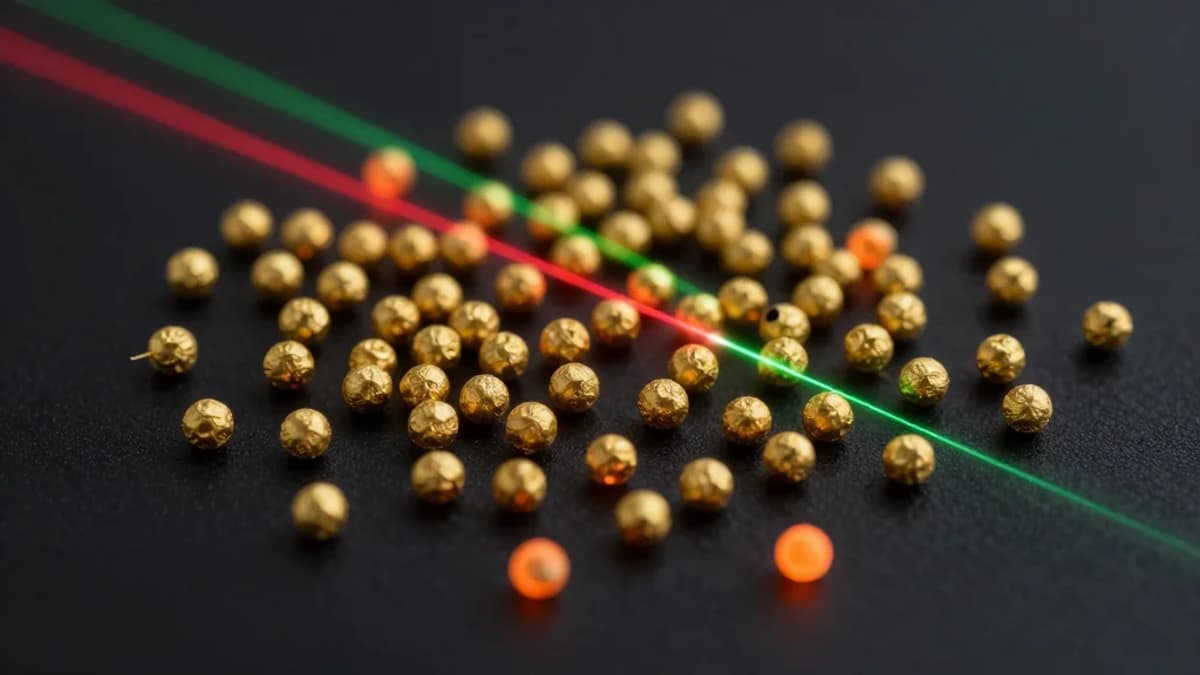
Gold Nanoparticles and Lasers Create Security Tags that Can Be Reset but Never Copied
•February 10, 2026
0
Why It Matters
Because the identity can be erased and regenerated without replacing hardware, manufacturers gain a sustainable defense against cloning attacks, reducing counterfeiting risk in aerospace, semiconductor, and medical device supply chains.
Key Takeaways
- •All‑optical fabrication, readout, and reconfiguration of gold‑nanoparticle PUFs.
- •384‑bit keys achieve near‑maximum Shannon entropy and pass NIST tests.
- •Machine‑learning attacks fail; cloning probability ~8.6×10⁻³⁰.
- •Optothermal nudging enables irreversible, unpredictable identity renewal.
- •Scalable to semiconductor, aerospace, and medical device supply chains.
Pulse Analysis
Counterfeiting threatens critical sectors ranging from aerospace to biomedical devices, costing billions annually and eroding trust in supply chains. Traditional security marks such as holograms or static electronic PUFs can be duplicated or permanently compromised once their physical patterns are exposed. The new all‑optical PUF leverages gold nanoparticles manipulated by focused lasers, removing the need for thermal or chemical processing and delivering a truly reconfigurable security primitive that can be refreshed on demand.
The core of the technology lies in plasmonic coupling: trapped nanoparticles fuse under localized heating, creating unique spatiospectral signatures that are captured as 384‑bit cryptographic keys. These keys exhibit near‑maximum Shannon entropy, pass the full NIST randomness suite, and maintain a Hamming distance close to 0.5 across devices, ensuring distinct identities. Rigorous testing showed that four machine‑learning models could not predict key bits better than random guessing, yielding an estimated cloning probability of 8.6×10⁻³⁰, a figure that places the system among the most secure optical PUFs reported.
Beyond its security merits, the platform’s reliance on standard optical inspection equipment aligns with existing quality‑control infrastructure in semiconductor fabs, defense manufacturers, and medical‑device producers. The optothermal nudging method enables irreversible, unpredictable re‑patterning, allowing a single component to receive multiple, statistically independent identities over its lifespan. As production scales through holographic optical‑tweezer arrays, throughput could meet industrial demands, positioning this technology as a sustainable, hardware‑agnostic solution for next‑generation anti‑counterfeiting strategies.
Gold nanoparticles and lasers create security tags that can be reset but never copied
0
Comments
Want to join the conversation?
Loading comments...