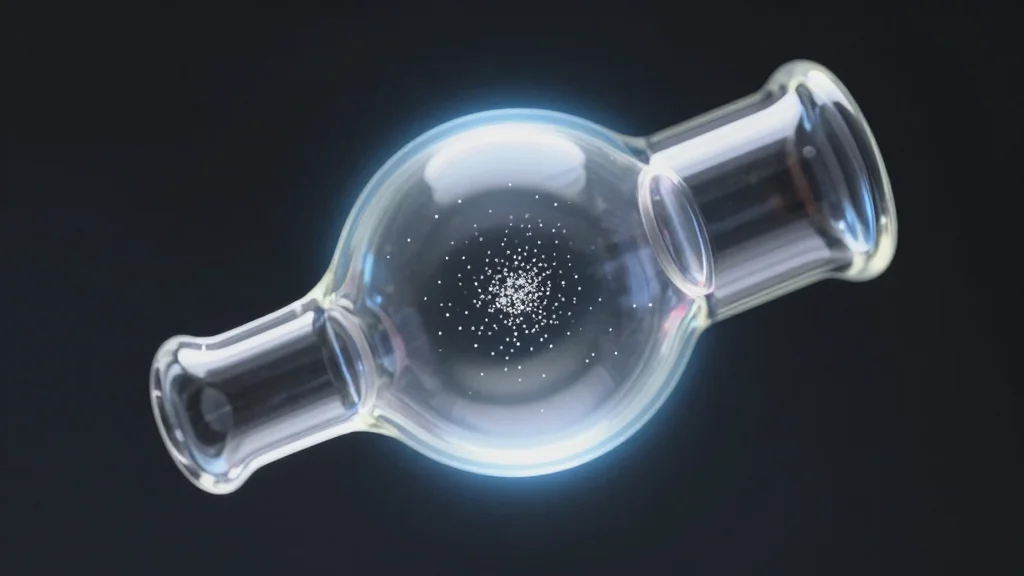
Gradient Wall Microbottle Resonator Enables Large Scale Optical Trapping
Key Takeaways
- •Gradient wall shields peak fields, reducing particle perturbation fivefold
- •Traps 500 nm particles across 195 µm with <0.2 mW power
- •Whispering‑gallery modes create tunable 3‑D standing‑wave traps
- •Quality factor reaches ~2.6 × 10⁷, enabling stable operation
- •Enables high‑throughput single‑cell analysis and label‑free sorting
Pulse Analysis
Near‑field optical trapping has become a workhorse for manipulating microscopic objects, yet conventional whispering‑gallery resonators rely on evanescent fields that extend only a few hundred nanometers from the surface. This shallow interaction limits trapping depth, reduces throughput, and makes the cavity highly sensitive to the presence of the trapped particle. The gradient‑thickness microbottle resonator redefines the field geometry by funneling the strongest optical antinodes into the fluid core while keeping the highest‑intensity regions buried within the silica walls. The result is a deeper, more uniform trapping potential that spans almost 200 µm.
Experimentally, the device achieves an ultra‑high quality factor of roughly 2.6 × 10⁷, enabling stable cavity enhancement with sub‑milliwatt input. By tapering the wall to one micrometer at the equator and thickening it toward the ends, the resonator confines peak electric fields at the axial extremities, reducing particle‑induced attenuation by more than five times compared with uniform‑wall designs. This architecture permits multi‑particle trapping across dozens of axial antinodes, each sustaining rotational velocities above 12 µm s⁻¹, while the power threshold for capture remains under 0.2 mW. Such low‑power operation is critical for integrating optical traps into portable lab‑on‑a‑chip systems.
The expanded trapping volume and precise 3‑D standing‑wave control open new avenues for high‑throughput biomedical assays, such as parallel single‑cell analysis or label‑free sorting of bacteria and yeast. Rapid orbital motion also enhances micromixing, potentially accelerating enzymatic reactions within microfluidic channels. To transition from laboratory proof‑of‑concept to commercial products, scalable fabrication methods—like advanced glass‑blowing combined with lithographic patterning—will be essential to maintain uniform wall gradients across large batches. As the industry seeks energy‑efficient, multifunctional optofluidic components, gradient‑thickness resonators are poised to become a cornerstone technology.
Gradient wall microbottle resonator enables large scale optical trapping
Comments
Want to join the conversation?