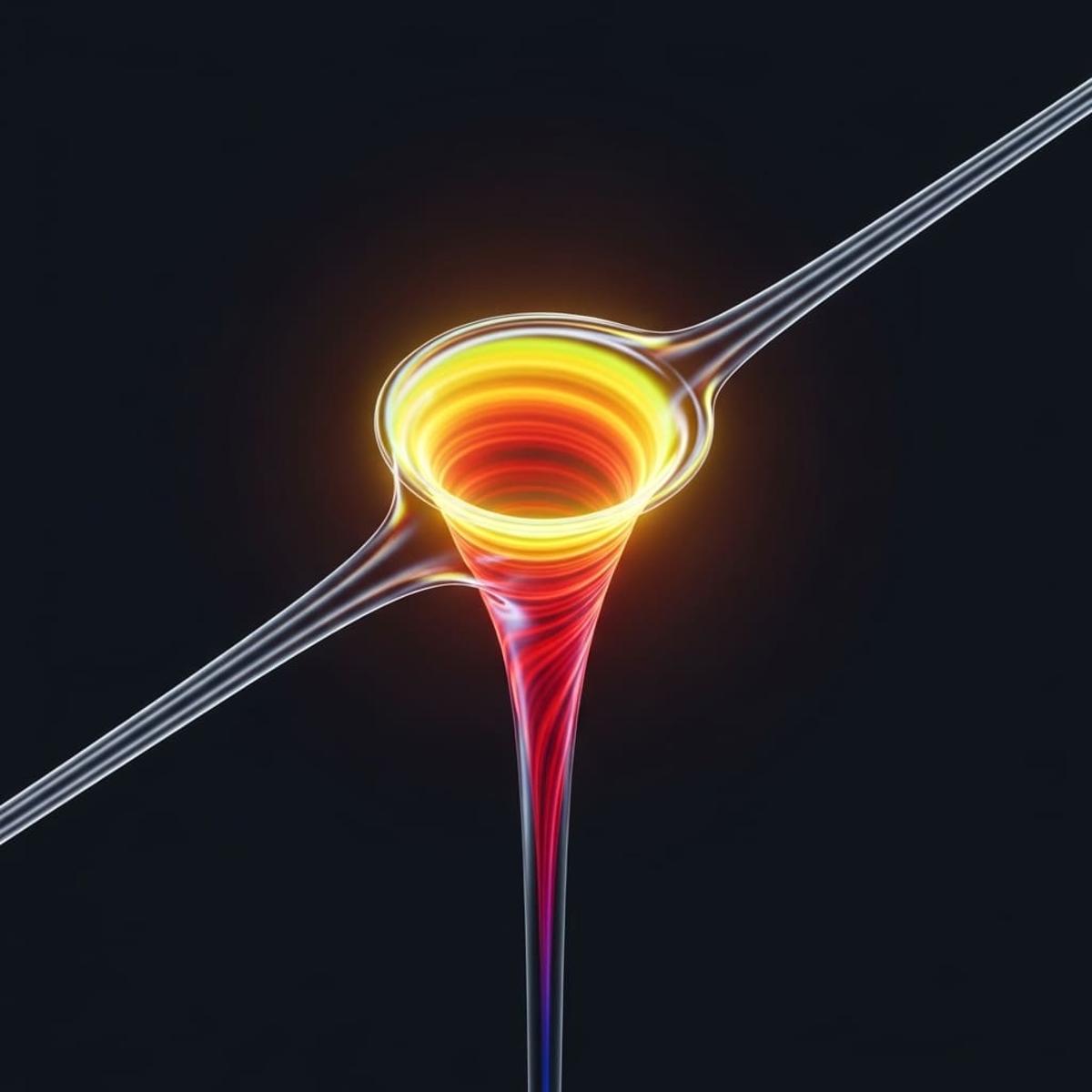
High-Q Resonators Achieve 10^7 Quality Factor with Optical Nanofiber Fabrication
•January 30, 2026
0
Why It Matters
The breakthrough provides a scalable route to ultra‑high‑Q nanophotonic components essential for quantum information processing and ultra‑fast, low‑energy optical switches, accelerating deployment of fiber‑based quantum networks.
Key Takeaways
- •Femtosecond laser ablation yields Q > 10⁷ nanofiber resonators
- •Thermo‑optic effects dominate nonlinear response even with ns pulses
- •Defect‑free photonic crystal cavities enable fast, low‑power switching
- •Mode volume ~10³ µm³ supports strong light‑matter interaction
- •Technique surpasses focused‑ion milling, improving fabrication reliability
Pulse Analysis
The pursuit of ultra‑high‑Q photonic components has long been limited by fabrication imperfections that introduce scattering loss and degrade cavity performance. Optical nanofibers, with diameters below a micron, offer tight mode confinement but traditionally suffered from low quality factors due to surface roughness and contamination from ion‑beam milling. By leveraging a single‑shot femtosecond laser ablation, the Waseda team sidesteps these drawbacks, achieving intrinsic Q‑values near 3 × 10⁷ while preserving the nanofiber’s mechanical stability. This level of performance opens new possibilities for on‑chip and fiber‑linked photonic circuits.
The process begins with a flame‑brush tapered fiber that is precisely shaped to a 500 nm waist, ensuring adiabatic mode transition and mechanical robustness. A frequency‑doubled 400 nm femtosecond pulse is then projected through a cylindrical‑lens pair onto a 5‑axis stage, carving periodic craters that form a Bragg grating with a 372.5 nm period. This direct‑write approach eliminates the need for masks or post‑processing, delivering defect‑free cavities whose thermo‑optic response exhibits a 24 kHz cutoff, enabling sub‑microsecond thermal tuning and ultra‑low‑power switching.
With quality factors surpassing 10⁷ and mode volumes on the order of 10³ µm³, these nanofiber resonators provide the strong light‑matter coupling required for cavity quantum electrodynamics and deterministic photon‑atom interfaces. Their rapid thermal dynamics make them attractive for reconfigurable optical networks, where low‑energy switches can route quantum information without degrading coherence. Commercially, the technique promises a cost‑effective, mask‑less production line for fiber‑based quantum processors and sensors, potentially accelerating the rollout of distributed quantum‑computing architectures and next‑generation telecommunication infrastructure.
High-Q Resonators Achieve 10^7 Quality Factor with Optical Nanofiber Fabrication
0
Comments
Want to join the conversation?
Loading comments...