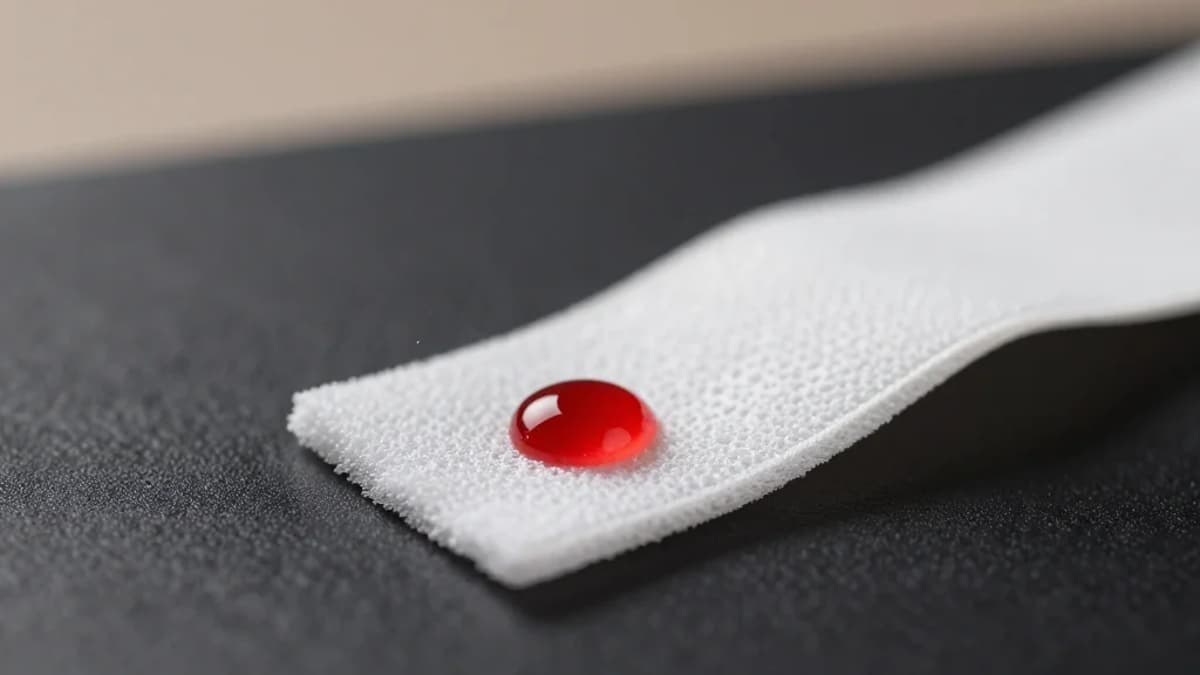
Accelerating clotting saves lives in severe trauma, offering a portable solution for first‑responders and soldiers and potentially reducing hemorrhagic‑shock mortality by 30‑40%.
Rapid hemostasis remains a bottleneck in trauma care, especially for internal injuries where direct pressure is ineffective. Conventional dressings rely on mechanical compression or topical agents that cannot reach deep vessels, leaving a critical gap during the "golden hour" after injury. The new nanocomposite leverages the intrinsic pro‑coagulant properties of nanosilicates—synthetic analogues of ancient clay hemostats—while embedding them in a smart matrix that activates at body temperature. This convergence of biomaterials science and thermal actuation addresses both delivery and retention challenges, ensuring the clotting agents stay localized.
The foam‑based system uses an expandable polyurethane scaffold that remains inert until injected, then swells to fill the wound cavity, physically trapping the nanosilicates and providing immediate mechanical closure. In parallel, the micro‑ribbon approach employs dual‑polymer ribbons that contract on one side, curling into a tangled, foam‑like mass that adheres to tissue. Both designs prevent particle migration, mitigating embolism risk, and simplify application—no tools or external power are required. By integrating shape‑memory behavior with biocompatible nanomaterials, the researchers have created a versatile platform adaptable to varied injury morphologies.
If translated to commercial products, these hemostats could reshape pre‑hospital protocols for civilian EMS, military medics, and remote disaster response teams. Their low‑cost, shelf‑stable formulation aligns with defense procurement priorities, while the clear mechanistic advantage may expedite FDA clearance under emergency use pathways. Market analysts project a multi‑billion‑dollar opportunity in the global trauma‑care sector, driven by rising demand for rapid, field‑deployable bleeding control. Continued testing in large‑animal models and human trials will be pivotal to validate safety, but the technology already signals a paradigm shift toward self‑applied, nanotechnology‑enhanced wound management.
February 18, 2026
Title: Researchers are using clay‑derived nanosilicates integrated into an expandable shape‑memory nanocomposite to create injectable hemostatic dressings that rapidly accelerate clotting and cut bleeding time in internal hemorrhage models.
(Nanowerk News) Traumatic injury is the third leading cause of death in the state of Texas, surpassing strokes, Alzheimer’s disease and diabetes, according to the Centers for Disease Control and Prevention. A massive number of these deaths are the result of uncontrolled bleeding.
“Severe blood loss can rapidly lead to hemorrhagic shock,” said Dr. Akhilesh Gaharwar, a biomedical engineering professor at Texas A&M University. “Many patients die within one to two hours of injury. This critical period is often referred to as the ‘golden hour.’”
Thanks to funding from the U.S. Department of Defense and the National Science Foundation, Gaharwar and his fellow researchers in the biomedical engineering department have found a way to extend this golden hour — using clay.
Gaharwar, Dr. Duncan Maitland and Dr. Taylor Ware are developing a suite of injectable hemostatic bandages — biomedical materials that stop bleeding and promote blood to clot faster. Their research is specifically targeting deep internal bleeding where traditional methods like compression are not possible.
Two papers, recently published in Advanced Science (“Expandable Nanocomposite Shape‑Memory Hemostat for the Treatment of Noncompressible Hemorrhage” – https://dx.doi.org/doi:10.1002/advs.202508439) and Advanced Functional Materials (“Shape‑Morphing Nanoengineered Hydrogel Ribbons as Hemostats” – https://dx.doi.org/doi:10.1002/adfm.202521053), demonstrate that these dressings can reduce bleeding time by almost 70%.
“Under normal circumstances, human blood clots within six to seven minutes,” said Gaharwar. “Using these hemostatic dressings, we are able to reduce the clotting time to one to two minutes.” The goal is a lifesaving device simple enough that a critically injured person could apply it to themselves immediately after injury.
“For a self‑applied or in‑the‑field‑applied device, you can’t use the fancy mechanics and apparatus that you would have in the operating room,” said Ware. “There can’t be any special tools. You have to have something that just works and works quickly.”
The research hinges on a class of materials that have been used for wound treatment for thousands of years. Certain naturally occurring clay minerals contain silicate‑based particles that can accelerate blood coagulation. The exact mechanics of this effect are still an active area of investigation.
“These clay particles were being used as a hemostat in ancient civilizations in China, Mesopotamia, Egypt, India, Greece and Rome, likely owing to their absorbency and tissue‑adherent properties,” said Gaharwar. “Ancient peoples would make a paste out of water and clay particles and apply it to wounds to stop bleeding faster.”
Fascinated by the particle’s blood‑clotting properties, Gaharwar began to explore the potential uses of a synthetic particle, which would avoid the potential risk of infection that comes with natural clays.
The challenge is getting this particle to the injury site and keeping it there. High blood flow washes powders and pastes away. Not only does this fail to stop the bleeding, it risks killing the patient in another way. The nanosilicate particles are small enough to easily travel through blood vessels to non‑injured areas of the body, causing life‑threatening blood clots and embolism.
With the help of Maitland’s lab, the researchers combined the nanosilicate particles with an expanding foam. While completely stable in its applicator device, the particle‑laced foam reacts to body heat. Once injected into a wound site, it expands to fill up the entire space, sealing severed blood vessels and holding the blood‑clotting nanosilicate exactly where it needs to be. Since the foam forms a single piece, there is no risk of particles breaking away and traveling to form dangerous blood clots in other areas of the body.
In Ware’s lab, the researchers took an entirely different approach: micro‑ribbons. This biomaterial is delivered in the form of multiple ribbon‑like structures, each covered in coagulation‑promoting nanosilicate particles.
Like the foam, the micro‑ribbons exploit the patient’s body heat to trigger a reaction once in place. Each ribbon is made of two different materials, only one of which reacts to body temperature. Once in contact with the patient’s body, one side of the ribbon contracts, causing it to curl. As multiple ribbons curl at the injury site, they tangle together to form a single foam‑like structure. Even if a single ribbon were able to escape, its size prevents it from traveling through blood vessels, keeping the blood‑clotting nanosilicate exactly where it needs to be.
The combined expertise of all three research labs may be responsible for the future of trauma care.
“If these materials get into the first‑aid kits in an ambulance as well as a soldier’s backpack, they can save a lot of lives,” said Gaharwar. “If you can save 30‑40 % of hemorrhagic shock victims, that is a big achievement.”
Comments
Want to join the conversation?
Loading comments...