Low-Frequency Excitations Could Soon Be Mapped with Nanometer Precision
Key Takeaways
- •WMCL maps terahertz excitations with nanometer resolution
- •Technique uses visible light, no terahertz detectors needed
- •Electron beam excites low‑frequency modes; laser mixes signals
- •Demonstrated on silver nanorods with retinal coating
- •Enables chemical identification in thin molecular layers
Pulse Analysis
The ability to probe low‑frequency excitations such as phonons, magnons, or plasmonic resonances with nanometer precision has long been a blind spot in nanoscience. Conventional infrared and terahertz spectroscopies excel at spectral resolution but are diffraction‑limited to micrometer scales, while scanning probe methods lack the necessary bandwidth. As a result, researchers have been unable to directly correlate local structural variations with far‑infrared fingerprints, limiting insight into heterogeneous materials, thin‑film chemistry, and nanoscale device performance and hampers the design of next‑generation photonic components.
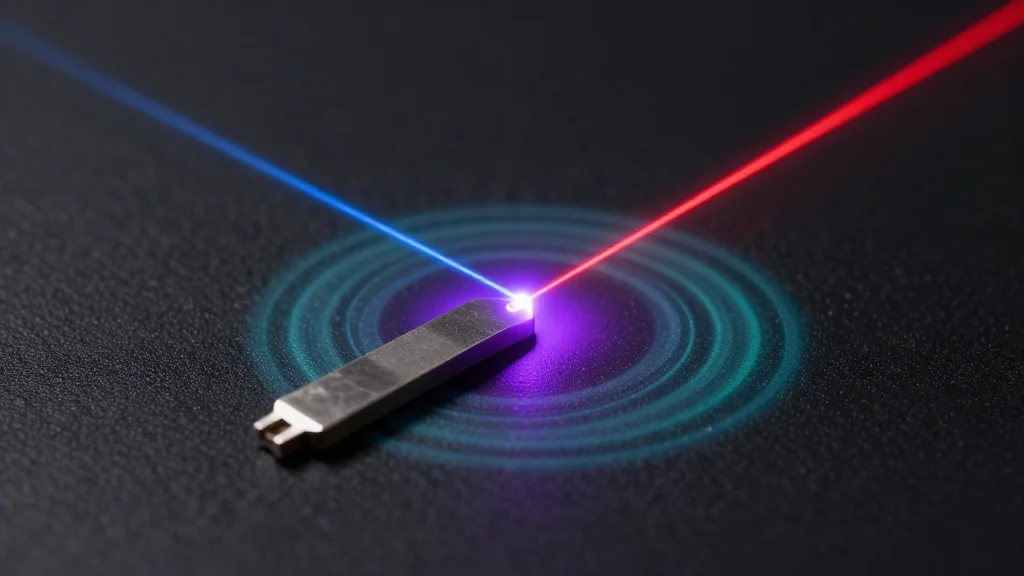
Wave‑mixing cathodoluminescence (WMCL) sidesteps these constraints by converting invisible terahertz information into a detectable shift of visible photons. An electron beam incident on the sample generates low‑frequency excitations, while a synchronized visible laser illuminates the same region. The nonlinear optical response of the material mixes the two fields, imprinting the terahertz frequency as a minute offset on the scattered laser light. Because the final signal remains in the visible range, standard spectrometers can capture it without specialized far‑infrared detectors, delivering nanometer‑scale maps of otherwise hidden modes. The approach also preserves sample integrity, as no high‑energy infrared beams are required.
The first theoretical demonstrations, including silver nanorods coated with retinal molecules, show that WMCL can differentiate chemical species within a few nanometers, opening a pathway to label‑free nanoscale spectroscopy. If experimental validation succeeds, the technique could accelerate research on energy‑conversion materials, quantum heterostructures, and bio‑interfaces where low‑frequency vibrations govern functionality. Moreover, because WMCL relies only on existing electron microscopes and visible lasers, it promises rapid adoption across labs. Future work will likely explore extending the method to magnetic excitations, two‑dimensional crystals, and in‑situ monitoring of device operation under realistic conditions. Such capability could transform quality control in semiconductor manufacturing by revealing hidden strain fields.
Low-frequency excitations could soon be mapped with nanometer precision
Comments
Want to join the conversation?