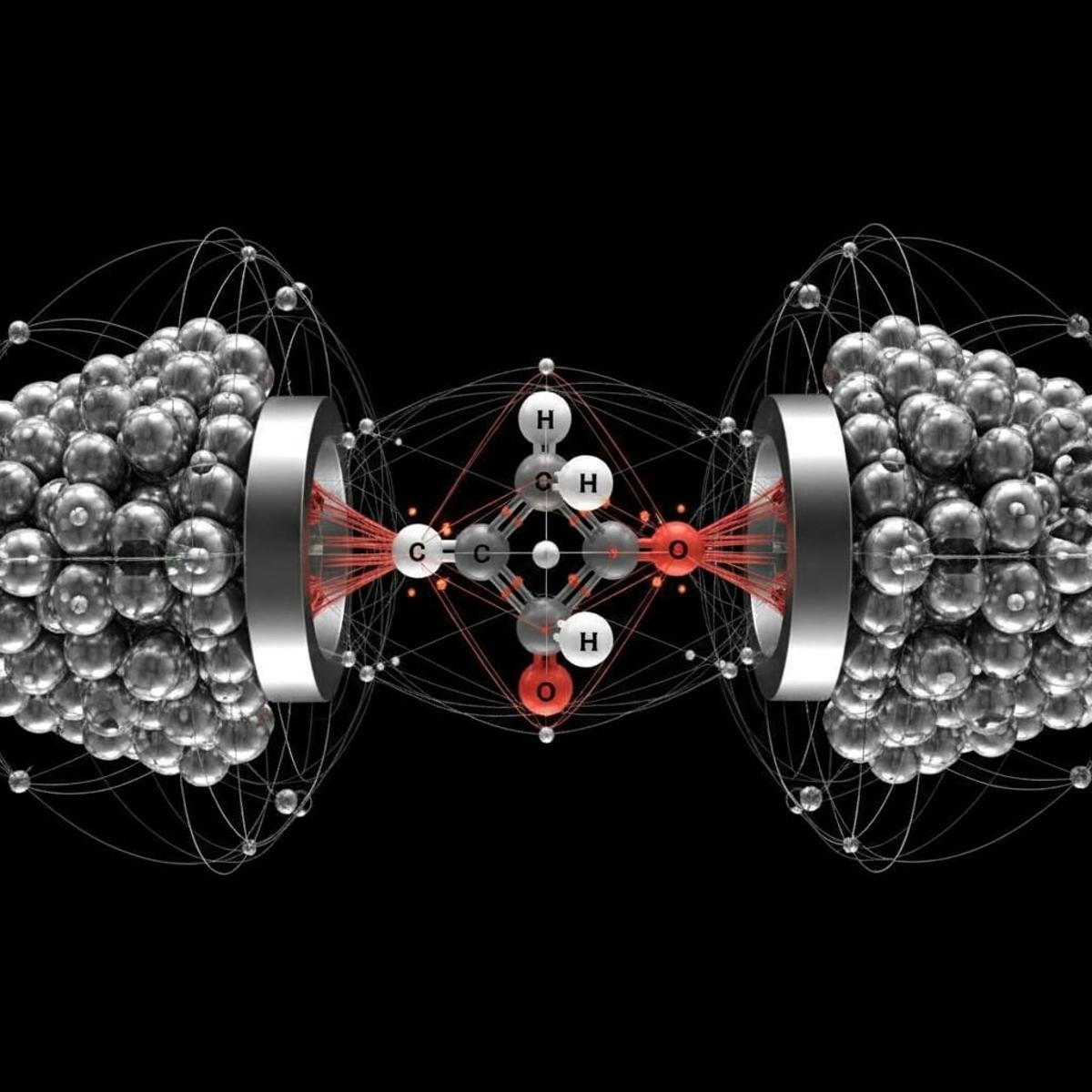
Molecular Hamiltonian Learning Extracts Parameters From Stm-Iets Data for Single Molecules
•February 2, 2026
0
Why It Matters
It turns qualitative STM spectroscopy into a precise tool for probing quantum magnetism, accelerating molecular spintronics and qubit development, while offering a scalable workflow for the broader materials community.
Key Takeaways
- •Machine learning extracts Hamiltonian parameters from STM‑IETS data
- •Algorithm separates tip‑induced effects from intrinsic molecular properties
- •Provides crystal‑field splitting, spin, SOC strength, orbital energies
- •Demonstrated on FePc on SnTe, mapping substrate interactions
- •Open-source code enables broader adoption across molecular spintronics
Pulse Analysis
Scanning tunneling microscopy combined with inelastic electron tunnelling spectroscopy (STM‑IETS) has long offered a window into the spin and orbital excitations of individual molecules, yet converting those spectra into concrete Hamiltonian parameters has required labor‑intensive fitting and restrictive assumptions. The lack of a systematic, quantitative pipeline has hampered progress in molecular spintronics, where precise knowledge of crystal‑field splitting, spin‑orbit coupling and Coulomb interactions is essential for device design. The recent introduction of molecular Hamiltonian learning addresses this gap by leveraging modern machine‑learning techniques to automate the inverse problem. The core of the approach is a supervised model trained on a comprehensive library of simulated STM‑IETS spectra that encode distance‑dependent tip perturbations, crystal‑field variations, many‑body Coulomb terms and spin‑orbit effects. By feeding the experimental set‑point‑dependent data into the trained network, the algorithm simultaneously retrieves the crystal‑field Hamiltonian, the spin value, SOC strength and orbital mixing with sub‑meV precision. Validation on iron‑phthalocyanine (FePc) adsorbed on a SnTe substrate demonstrated accurate reconstruction of interfacial screening, chemical gating and substrate‑induced orbital hybridisation, confirming that tip‑induced shifts can be cleanly separated from intrinsic molecular characteristics. Making the code and training datasets openly available transforms this proof‑of‑concept into a community resource, enabling rapid adoption across a variety of molecular platforms and substrates. For the quantum‑materials industry, the ability to extract Hamiltonian parameters at the single‑molecule level promises faster screening of candidate spin qubits, more reliable modeling of molecular spintronic junctions, and tighter integration between experimental spectroscopy and theoretical design. Future work that incorporates experimental spectra directly into the training loop could further improve robustness, extending the technique to larger, more complex systems and accelerating the commercialization of molecular quantum technologies.
Molecular Hamiltonian Learning Extracts Parameters from Stm-Iets Data for Single Molecules
0
Comments
Want to join the conversation?
Loading comments...