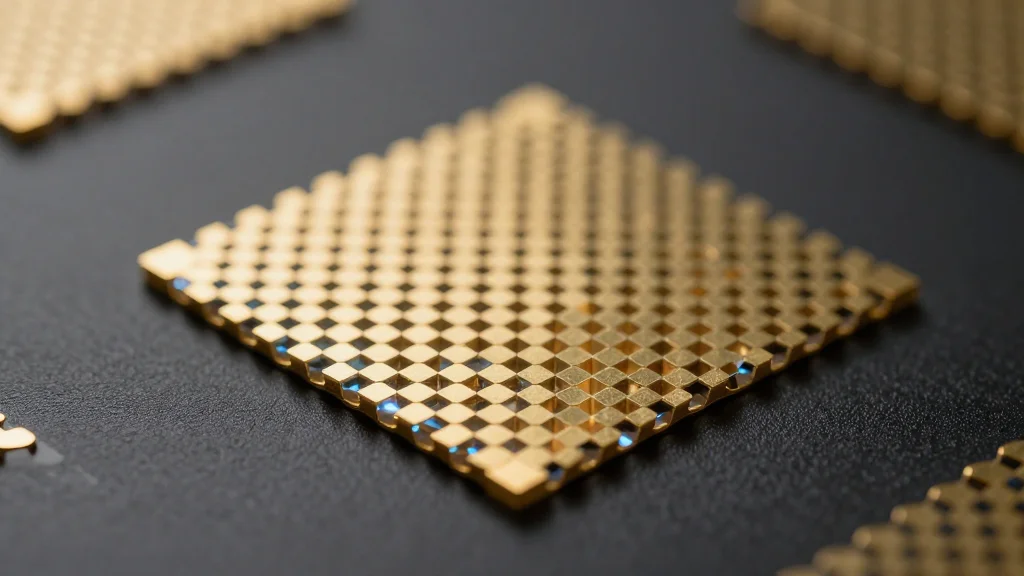
Nano-Kirigami Creates Programmable Optical Pixels From Folding Gold
Key Takeaways
- •Turn-shaped gold pixels achieve >60% reflectance modulation at 32 V
- •100×100 matrix delivers 10,000 individually addressable folding pixels
- •3.87 million-pixel chip uses stripe electrodes for line-by-line control
- •Pixel pitch 2.5 µm beats DMD minimum but wiring remains challenge
Pulse Analysis
Nano‑kirigami leverages cut‑and‑fold mechanics at the nanoscale, turning thin gold films into electromechanically actuated optical pixels. When a voltage is applied between the gold and an underlying silicon substrate, electrostatic attraction pulls a central plate downward, bending slender arms that scatter light. This physical reshaping produces a clear optical state change without altering the light source, delivering contrast levels that rival traditional micro‑mirrors while using far less material. The turn‑shaped geometry maximizes active area, achieving more than 60% reflectance modulation across the visible spectrum at modest voltages.
Scaling the concept required inventive addressing schemes. A crossed‑electrode matrix with 100 rows and 100 columns gave researchers 10,000 individually selectable pixels, each spaced 4.8 µm apart—still finer than many commercial spatial light modulators. Pushing further, the team fabricated a 3.87 million‑pixel chip with a 2.5 µm pitch, grouping units into 200 long stripe electrodes that switch en masse. This line‑by‑line architecture reduces wiring complexity while preserving the ultra‑dense layout, and the spiral nano‑kirigami pattern lowers actuation voltage to 18 V, highlighting the trade‑off between pixel performance and scalability.
The implications extend beyond experimental optics. Ultra‑dense, voltage‑controlled surfaces could enable next‑generation augmented‑reality displays, adaptive lenses for telescopes, or low‑power beam‑steering arrays for LiDAR. However, challenges remain: ensuring uniform actuation across millions of units, integrating driver electronics at sub‑micron scales, and improving long‑term mechanical reliability. Continued advances in nanofabrication and materials engineering will be crucial to bridge the gap between laboratory prototypes and commercial devices, potentially reshaping the landscape of programmable photonic hardware.
Nano-kirigami creates programmable optical pixels from folding gold
Comments
Want to join the conversation?