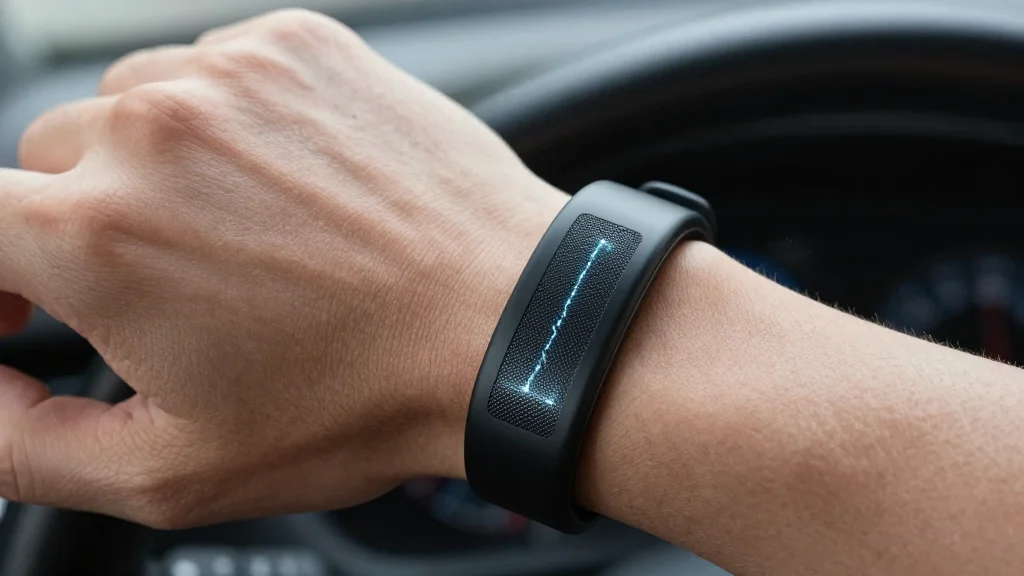
Nanoengineered Wrist Sensor Detects Driver Fatigue Through Pulse Wave Analysis
Key Takeaways
- •Triboelectric wrist sensor achieves 4.28 V/kPa sensitivity.
- •98% fatigue classification accuracy using 1‑D CNN.
- •Detects pulse waves under 10 kPa preload, 2 Pa limit.
- •Monitors blinks, yawning, pedal use, seat occupancy, belt status.
- •Provides real‑time alerts, aiming to reduce traffic fatalities.
Pulse Analysis
The breakthrough stems from a dual‑interface triboelectric architecture that tackles two long‑standing hurdles in wearable bio‑monitoring: weak signal amplitude and inconsistent skin contact. By embedding piezo‑frustums at the skin interface and mountain‑like microstructures in the triboelectric layer, the sensor creates a mechano‑electric coupling effect that boosts voltage output to 4.28 V/kPa and resolves fine pulse‑wave morphology even under a 10 kPa preload. This engineering advance narrows the gap between laboratory‑grade sensors and everyday wearables, enabling reliable heart‑rate‑variability extraction for health and safety applications.
Beyond hardware, the integration of a one‑dimensional convolutional neural network transforms raw pulse data into actionable fatigue indicators. The model leverages subtle changes in pulse shape, beat-to-beat intervals and waveform peaks to distinguish alert from drowsy states, achieving 98 percent classification accuracy in trials. Compared with camera‑based driver‑monitoring systems that react only after visual cues of drowsiness appear, this physiological approach offers earlier warnings, potentially preventing accidents before driver performance deteriorates.
The commercial implications are significant. Automakers and fleet operators are increasingly seeking non‑intrusive, cost‑effective safety solutions, and a wrist‑worn device that doubles as a health monitor fits that demand. Coupled with Bluetooth connectivity and a mobile app, the platform can be scaled into a broader safety network that aggregates biometric and behavioral data. As regulatory bodies tighten standards for driver alertness, technologies that deliver real‑time, high‑accuracy fatigue detection are poised to become integral components of next‑generation vehicle safety suites.
Nanoengineered wrist sensor detects driver fatigue through pulse wave analysis
Comments
Want to join the conversation?