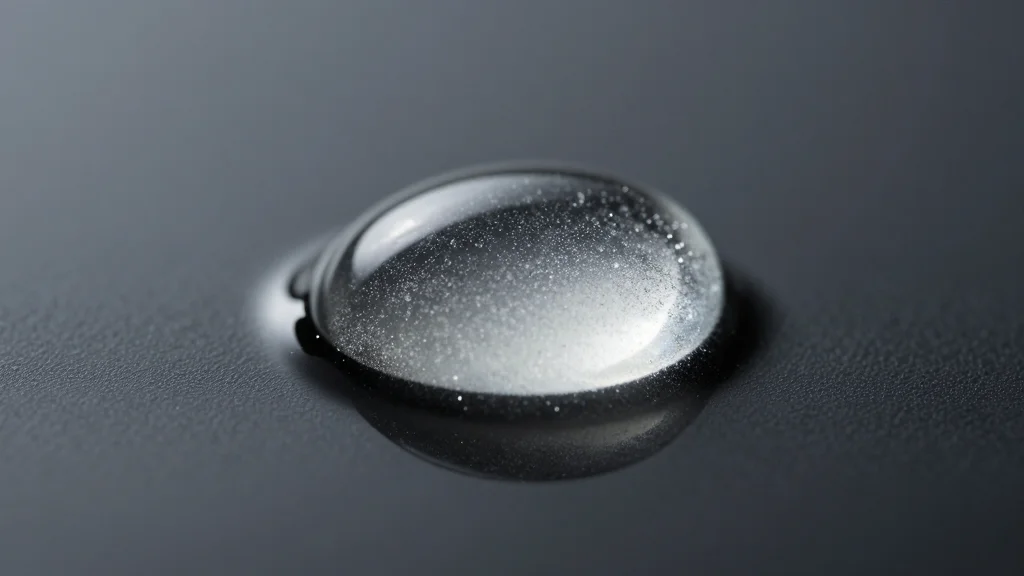
Near-Frictionless Motion of Pico- to Nanoliter Droplets with Liquid-Repellent Particle Coating
Key Takeaways
- •Particle coating reduces droplet friction to sub‑nanonewton.
- •Enables pico‑ to nanoliter droplet handling like dry powder.
- •Preserves droplet deformability for merging and splitting.
- •Cuts required repellent volume by 3–4 orders magnitude.
- •Potential to miniaturize assays, cutting reagent waste.
Pulse Analysis
Microfluidic platforms rely on the controlled transport of tiny liquid parcels, yet once volumes shrink to the picoliter or nanoliter range, surface roughness and interfacial friction become dominant obstacles. Traditional approaches focus on polishing substrates or applying superhydrophobic coatings, but these solutions still demand relatively thick liquid‑repellent layers and cannot fully eliminate stick‑slip behavior. The MANA team’s particle‑based coating flips this paradigm by wrapping each droplet in a nanometer‑scale armor, allowing it to glide as if it were a dry grain.
The coating is formed by an ultrasonic spray of fluorocarbon‑modified fumed titania particles only 20 nm across, creating a dynamic shell that contacts the solid substrate directly. Measurements show sliding forces drop to sub‑nanonewton levels, a reduction of three to four orders of magnitude compared with conventional liquid‑repellent interfaces. Because the particle layer is only a few nanometers thick, the droplet retains its native surface tension, enabling it to merge, split, or reshape on demand. This performance opens design space for ultra‑compact pumps, valves, and soft microrobots that operate without bulky external actuators.
Beyond device engineering, the ability to manipulate picoliter volumes with near‑zero friction promises substantial cost and environmental benefits. Diagnostic assays and chemical syntheses could be performed using orders of magnitude less reagent, cutting waste and accelerating high‑throughput screening. Moreover, the particle‑coated “micro liquid marble” concept may inspire new classes of self‑propelling droplets for soft robotics or collective droplet computing. Ongoing research will likely explore alternative particle chemistries, scalability, and integration with existing lab‑on‑a‑chip platforms, cementing its role in the next wave of nanofluidic innovation.
Near-frictionless motion of pico- to nanoliter droplets with liquid-repellent particle coating
Comments
Want to join the conversation?