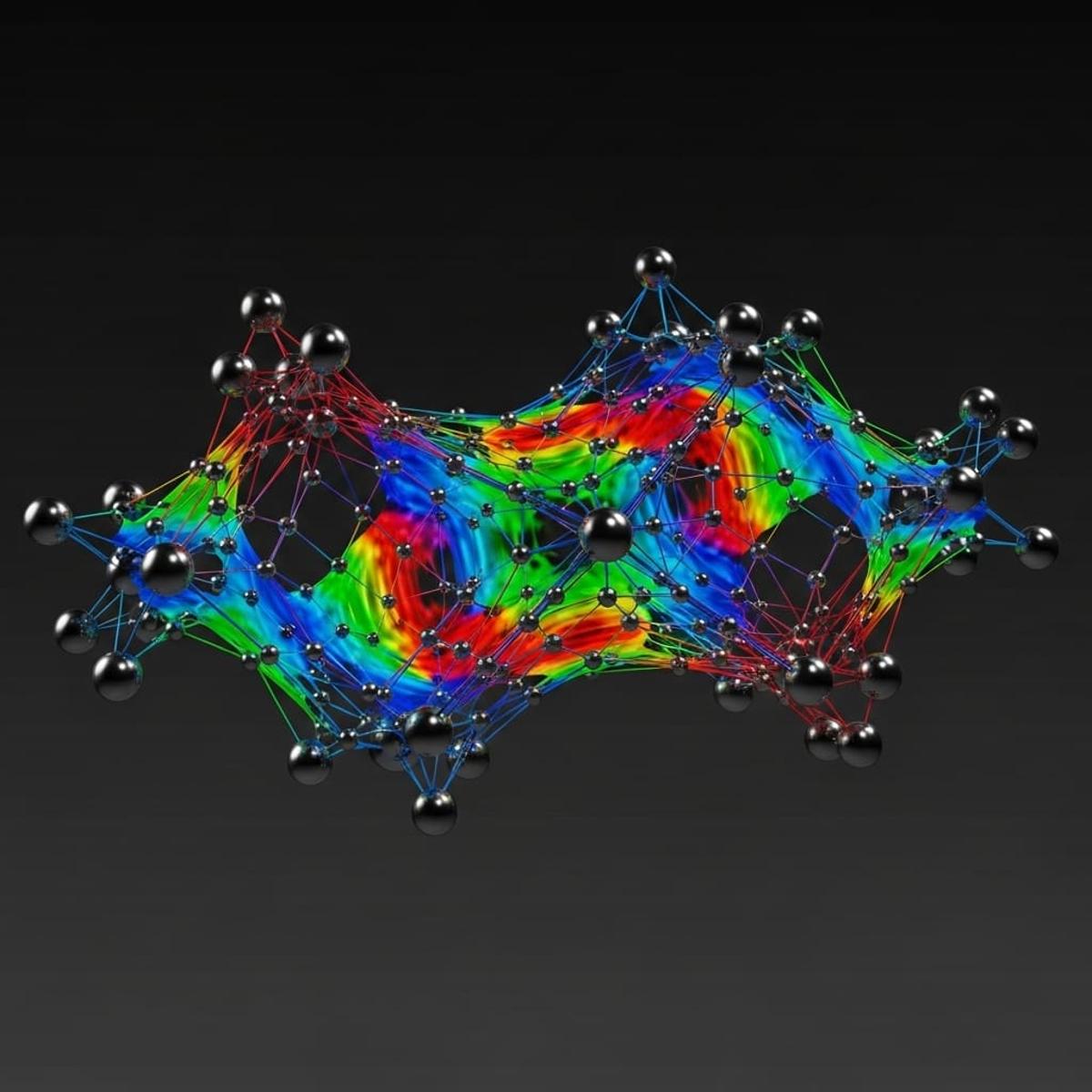
New 2D Material Links Strain and Magnetism in a Novel Way
•February 6, 2026
0
Why It Matters
The discovery provides a pathway to control magnetic properties through mechanical deformation, opening new design space for low‑energy spintronic technologies.
Key Takeaways
- •Strain creates Dirac dipole, inducing orbital magnetization.
- •Effect arises from topological properties of Dirac quadrupole semimetal.
- •Models: spinless two‑band and Lieb‑lattice capture response.
- •Candidate 2D altermagnets include V₂Se₂O and La₂O₃Mn₂Se₂.
- •Enables magnetic control via mechanical deformation, no spin currents.
Pulse Analysis
Altermagnets have emerged as a distinct class of magnetic materials where spin‑polarized bands coexist with zero net magnetization. Within this family, Dirac quadrupole altermagnets stand out because their low‑energy electrons form a quadrupolar arrangement of Dirac points, a topology that governs both electronic transport and magnetic response. By treating strain as a geometric perturbation, researchers reveal that the Dirac points shift asymmetrically, creating a dipolar configuration that directly couples to orbital angular momentum. This topological link bypasses conventional spin‑orbit mechanisms, offering a purer route to magnetization control.
Theoretical analysis relies on two complementary minimal models. The spinless two‑band framework isolates orbital contributions by focusing on an s‑d band inversion, while the Lieb‑lattice model reproduces the collinear Néel order characteristic of many 2D altermagnets. Both approaches demonstrate that the orbital piezomagnetic polarizability can be expressed through response‑theory formulas involving Berry curvature and quantum geometry. Crucially, the strain‑induced Dirac dipole acts as a source term for orbital magnetization, producing a measurable magnetic moment proportional to the applied deformation. These insights clarify how topology, symmetry, and lattice mechanics intertwine in a way that is absent from traditional ferromagnets or topological insulators.
From an application standpoint, the ability to toggle magnetization with strain opens avenues for ultra‑low‑power spintronic components such as magnetic sensors, memory bits, and logic gates that avoid Joule heating from current‑driven switching. Candidate materials—V₂Se₂O, V₂Te₂O, their alkali‑intercalated derivatives, and the correlated insulator La₂O₃Mn₂Se₂—already exhibit the requisite Lieb‑lattice motif, making experimental verification feasible. Future work will likely explore heterostructure engineering, disorder effects, and electron‑interaction enhancements to optimize the piezomagnetic response, potentially establishing strain‑engineered altermagnets as a cornerstone of next‑generation quantum devices.
New 2D Material Links Strain and Magnetism in a Novel Way
0
Comments
Want to join the conversation?
Loading comments...