New Molecular Design Produces Bright Twisted Light in the Near Infrared
Key Takeaways
- •Emit circularly polarized light from 650 nm to 800 nm.
- •Quantum yield 30× higher than prior chiral radicals.
- •Photostability improves ~100×, lasting over 1,300 seconds under laser.
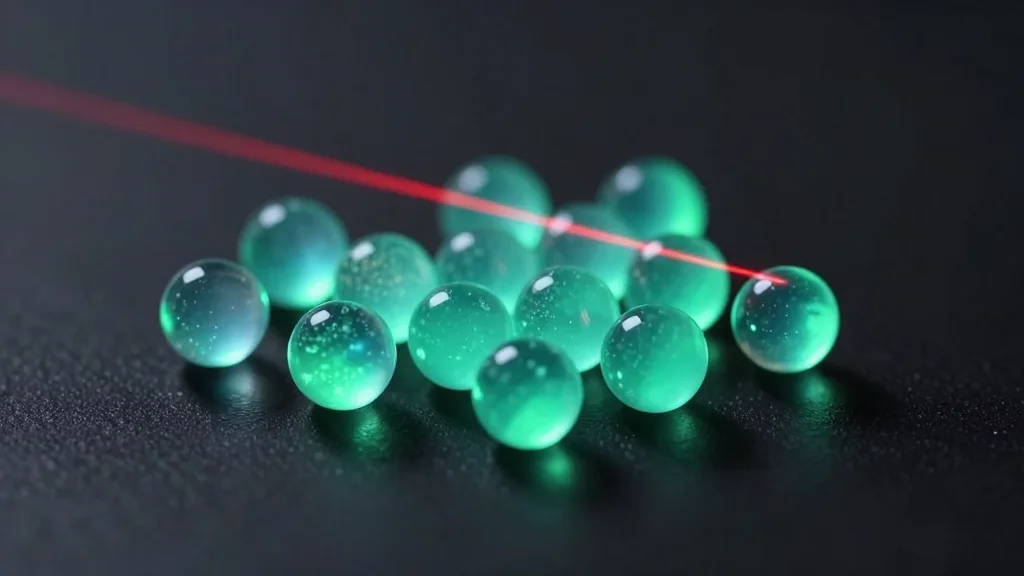
- •Embedded in polystyrene microspheres, radicals show whispering‑gallery pre‑lasing.
- •Potential uses span 3D displays, deep‑tissue imaging, and quantum information.
Pulse Analysis
Circularly polarized light (CPL) is a cornerstone of emerging photonic technologies, from stereoscopic displays that require distinct left‑ and right‑handed wavefronts to deep‑tissue bio‑imaging where polarization can enhance contrast. Historically, generating CPL efficiently in the red and near‑infrared (NIR) spectrum has been hampered by low quantum yields and rapid photodegradation of chiral emitters. The Kyushu team’s approach—integrating carbazole donor groups onto a tris(2,4,6‑trichlorophenyl)methyl (TTM) radical scaffold—reconfigures the electronic transition from a localized to a charge‑transfer mechanism, shifting emission into the 650‑800 nm band while preserving molecular chirality.
Performance metrics underscore the significance of this molecular redesign. The top‑ranked radical delivers a photoluminescence quantum yield roughly thirty times that of conventional chiral radicals, translating to markedly brighter CPL output. Simultaneously, photostability is boosted by a factor of about one hundred, with continuous laser irradiation tolerances exceeding 1,300 seconds versus under 20 seconds for unmodified analogues. Such durability is critical for real‑world devices that demand sustained illumination, such as laser sources and optical sensors. Moreover, the radicals maintain high racemization barriers, allowing isolation of enantiopure samples that consistently produce strong circularly polarized luminescence.
Beyond brightness and robustness, the study reveals a novel pre‑lasing phenomenon: when the radicals are incorporated into polystyrene microspheres, they support whispering‑gallery mode resonance, concentrating light within the spherical cavity. This effect hints at compact, low‑threshold laser architectures that could be integrated into on‑chip photonic circuits. The broader impact spans multiple sectors—high‑definition 3D displays, NIR bio‑probes capable of deeper tissue penetration, and spin‑active quantum materials for information processing. As the industry seeks scalable, organic‑based CPL sources, Kyushu University’s design offers a compelling template for next‑generation optoelectronic and quantum devices.
New molecular design produces bright twisted light in the near infrared
Comments
Want to join the conversation?