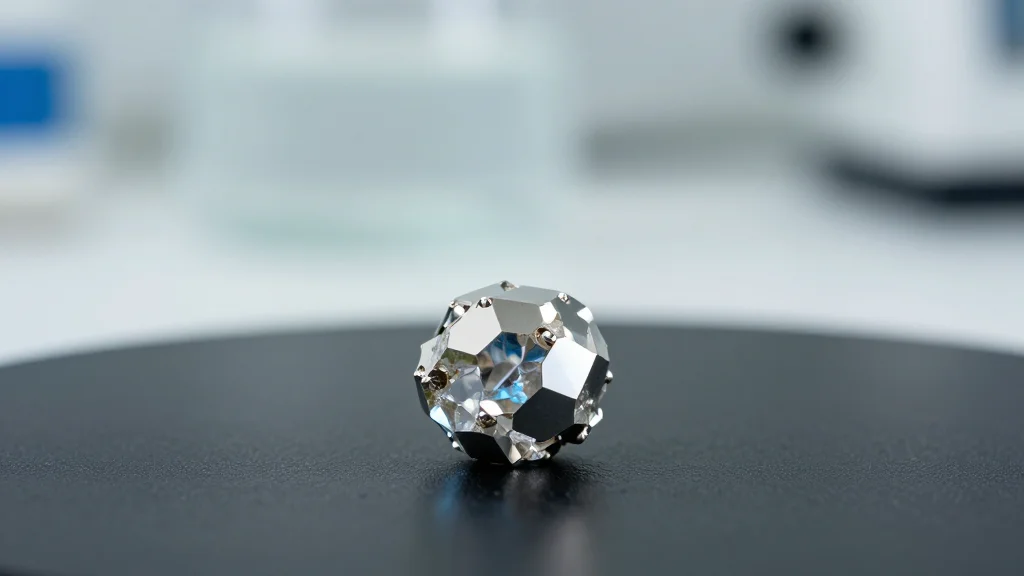
Newly Synthesized Fullerene Material Remains Metallic Even Under Low Temperatures
Key Takeaways
- •Yb2CsC60 retains metallic conductivity down to cryogenic temperatures.
- •Single-hole p‑orbital configuration prevents Mott insulating transition.
- •Hund’s coupling aids electron mobility in the fulleride, unlike typical insulators.
- •Findings bridge behavior of p‑electron molecular systems and d‑electron compounds.
- •Potential pathway to unconventional superconductivity in related molecular materials.
Pulse Analysis
The breakthrough centers on Yb₂CsC₆₀, a fullerene‑based compound that defies the classic Mott metal‑insulator transition. In conventional strongly correlated materials, increasing electron‑electron interactions trap charge carriers, driving the system into an insulating state at low temperatures. By engineering a valence of 5‑ on the C₆₀ cage, the researchers created a single‑hole, nearly filled p‑orbital band that remains conductive even under cryogenic conditions, a rare feat for molecular solids.
Underlying this resilience is an unexpected role for Hund’s coupling. While in half‑filled d‑orbital systems Hund’s rule often reinforces localization, in the p‑orbital fulleride it aligns spins in a way that preserves mobility. This mirrors phenomena observed in transition‑metal oxides but had not been documented for light‑element molecular materials. The result bridges two previously distinct classes of quantum matter, prompting theorists to revisit models of electronic correlations across orbital types.
Looking ahead, the robust metallic state of Yb₂CsC₆₀ could serve as a stepping stone toward unconventional superconductivity in fulleride families. If similar compounds can be tuned to enhance pairing interactions, they may enable low‑temperature superconductors with applications ranging from quantum computing to energy‑efficient power transmission. Moreover, the study underscores the value of interdisciplinary collaboration—combining synthesis, spectroscopy, and advanced theory—to unlock novel quantum functionalities that could reshape future electronic and energy technologies.
Newly synthesized fullerene material remains metallic even under low temperatures
Comments
Want to join the conversation?