Novel Microfluidic Method Improves Nanoparticle Separation Accuracy
•February 10, 2026
0
Why It Matters
This breakthrough offers a faster, more reliable way to isolate nanoscale biomarkers, accelerating diagnostic development and cutting costs for biotech labs. It also paves the way for scalable production of purified extracellular vesicles for therapeutic applications.
Key Takeaways
- •Electro‑viscoelastic microfluidics boosts nanoparticle purity up to 50%
- •Method works in standard channels, avoiding clog‑prone nanofluidics
- •Enables faster, scalable sorting for extracellular vesicle diagnostics
- •Combines electrophoretic slip lift with viscoelastic lateral forces
- •Potential applications include blood analysis, cancer research, nanomedicine
Pulse Analysis
Separating particles at the nanoscale has long been a bottleneck for biotechnology. Below a few hundred nanometres, Brownian motion dominates, rendering conventional hydrodynamic or sieving forces ineffective. Existing solutions—nanofluidic channels, ultracentrifugation, or affinity capture—often require high pressures, long processing times, or complex chemistries, limiting throughput and scalability. The need for gentle yet precise purification is especially acute for extracellular vesicles, whose diagnostic value hinges on preserving delicate cargo while eliminating contaminants.
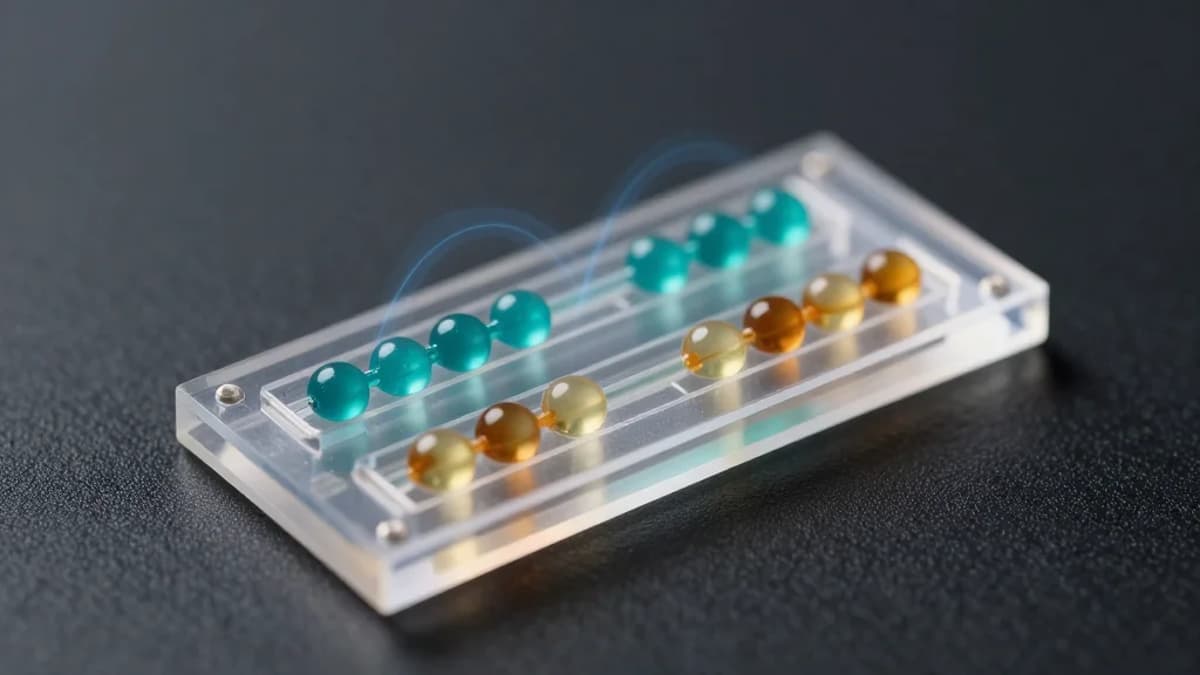
The Oulu team’s electro‑viscoelastic strategy tackles these challenges by exploiting two synergistic phenomena. An applied electric field generates a slip flow that lifts particles without direct electrophoretic pull, while a viscoelastic carrier fluid creates lateral forces absent in water‑based media. Together they produce a controllable net force that can discriminate particles differing by mere tens of nanometres. In proof‑of‑concept experiments, polystyrene beads saw purity gains of 30‑50%, and cancer‑cell vesicles improved by more than 20%. Crucially, the process runs in ordinary microchannels, sidestepping the clogging and pressure issues that plague nanofluidic devices, and it can be scaled by parallelizing channels or increasing flow rates.
The implications for the life‑science market are significant. Faster, higher‑purity vesicle isolation could accelerate biomarker discovery, enabling earlier disease detection and more reliable liquid‑biopsy platforms. Pharmaceutical pipelines that rely on extracellular vesicles for drug delivery stand to benefit from reduced manufacturing complexity and cost. Moreover, the technique’s compatibility with standard microfluidic fabrication lowers entry barriers for startups and established firms alike, potentially spurring a new wave of commercial kits and integrated analysis systems. As the industry pushes toward personalized medicine, tools that combine precision, speed, and scalability—like this electro‑viscoelastic separator—will become essential components of the diagnostic and therapeutic ecosystem.
Novel microfluidic method improves nanoparticle separation accuracy
0
Comments
Want to join the conversation?
Loading comments...