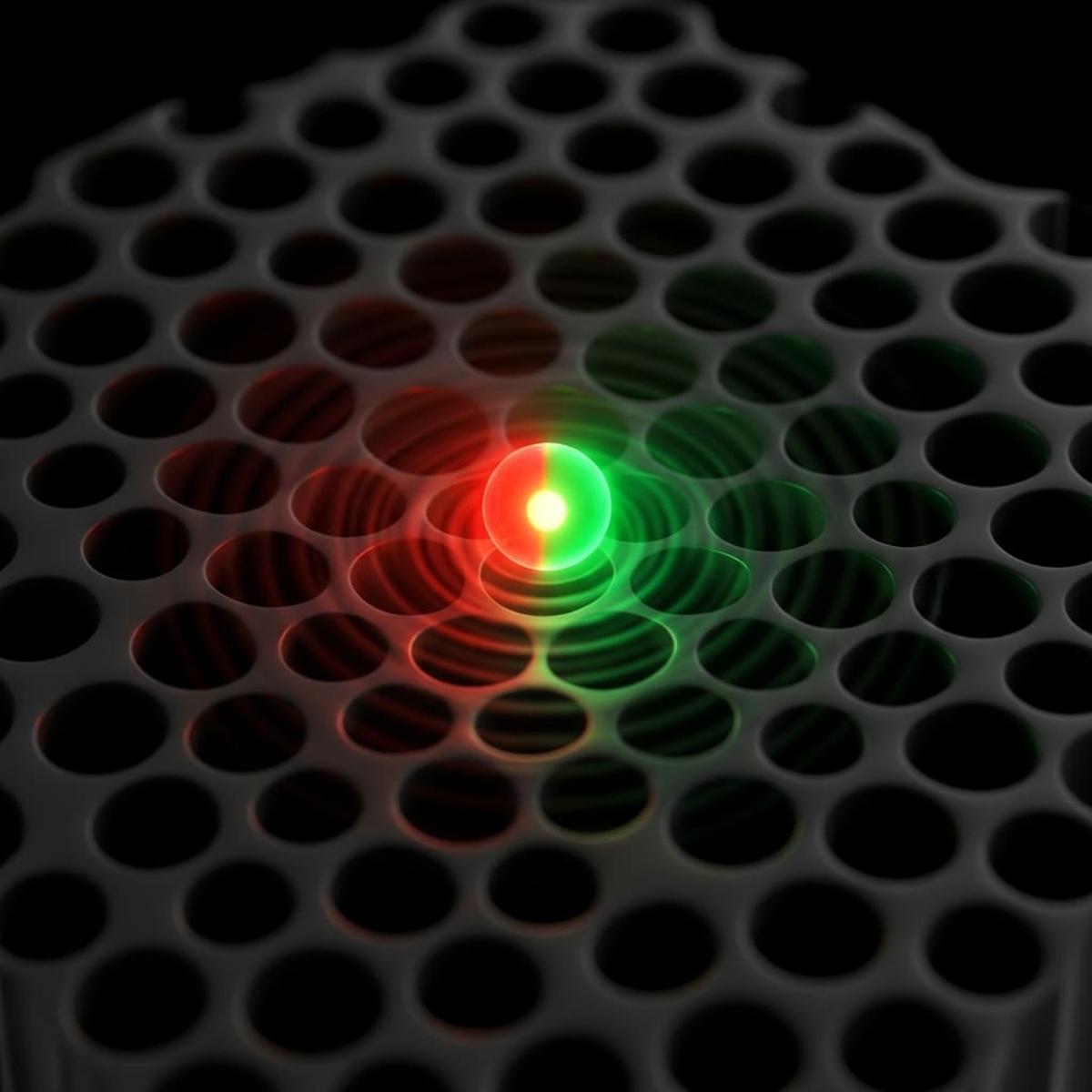
Quantum Dots Achieve 0.7 Energy Shifts Via Phononic Crystal Waveguide Coupling
•January 21, 2026
0
Why It Matters
The ability to shift quantum‑dot energies with modest acoustic fields enables precise, on‑chip quantum control and scalable phononic‑optical transduction, a critical step for quantum communication and sensing networks.
Key Takeaways
- •Energy shifts reach 0.7 meV via GHz phononic waveguide.
- •Symmetry and dot placement drive coupling strength.
- •W1m design broadens mechanical bandgap, supports sideband regime.
- •Piezoelectric strain links acoustic waves to quantum dot charge.
- •Platform compatible with InGaAs, GaAs/AlGaAs quantum dots.
Pulse Analysis
The convergence of quantum‑dot technology and engineered phononic crystals is reshaping how researchers manipulate solid‑state qubits. While optical and electrical gating have dominated quantum‑dot control, recent advances demonstrate that elastic waves confined in periodic structures can exert comparable, highly localized strain. By tailoring the dispersion of a snowflake‑type phononic lattice, engineers can generate gigahertz‑frequency acoustic modes that interact resonantly with the electronic states of InGaAs/GaAs and GaAs/AlGaAs dots, opening a new dimension of strain‑based quantum control.
In the latest theoretical work, a hybrid modeling framework merges k·p band‑structure calculations with configuration‑interaction many‑body techniques, capturing both deformation‑potential and piezoelectric contributions to the dot‑phonon coupling. The authors identify mode symmetries that either enhance or suppress interaction, and they pinpoint optimal dot locations within the waveguide cross‑section to maximize the 0.7 meV energy shift. The W1m waveguide variant, created by strategically shifting snowflake holes, widens the mechanical bandgap and sustains a resolved‑sideband regime, essential for coherent phonon‑mediated quantum transduction.
These insights have immediate relevance for scalable quantum hardware. A phononic‑crystal platform that integrates high‑Q mechanical resonators with optically active quantum dots can serve as an on‑chip transducer, converting microwave or RF signals into optical photons with minimal loss. Such capability supports quantum networking, where acoustic channels bridge superconducting processors and photonic links, and it underpins precision sensing applications that exploit strain‑induced shifts for ultra‑sensitive force detection. As fabrication techniques mature, the demonstrated compatibility with existing epitaxial quantum‑dot processes suggests a clear pathway toward commercial hybrid quantum devices.
Quantum Dots Achieve 0.7 Energy Shifts Via Phononic Crystal Waveguide Coupling
0
Comments
Want to join the conversation?
Loading comments...