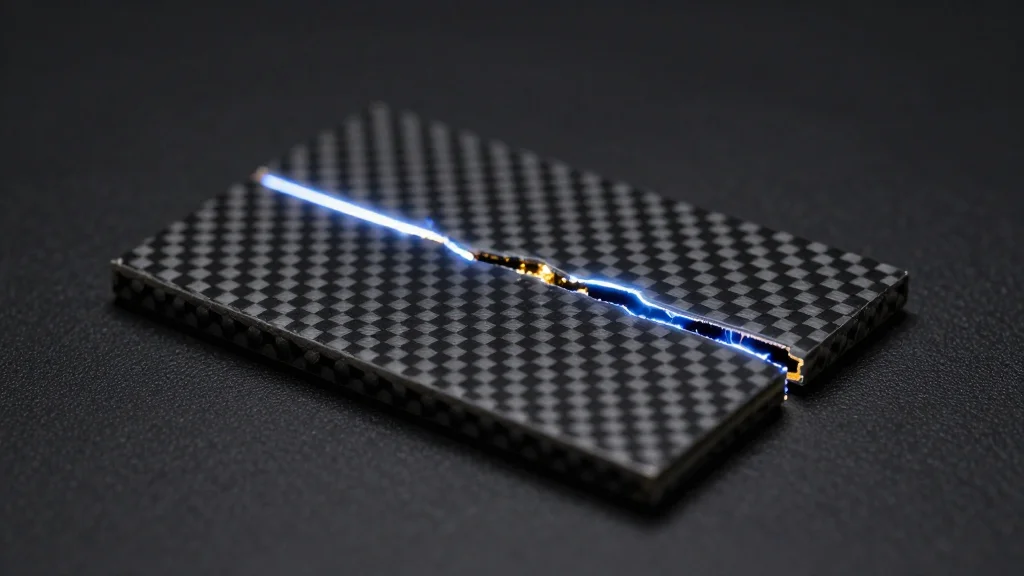
Self-Powered Nanocomposite Material Detects Its Own Cracks
Key Takeaways
- •Self-powered CFRP generates up to 13.6 V under vibration
- •Crack length reduces voltage and resonant frequency
- •Uses lead‑free KNN nanomaterials for safety
- •Enables wireless, battery‑free structural health monitoring
- •Potential applications in aerospace, automotive, wind turbines
Pulse Analysis
Structural health monitoring (SHM) has long relied on wired sensor networks and battery packs, adding weight and complexity to high‑performance structures. As aircraft, wind turbines and electric vehicles push the limits of lightweight design, engineers seek solutions that can both power themselves and provide real‑time damage data. Energy‑harvesting composites address this gap by converting ambient vibrations into usable electricity, removing the need for separate power sources and simplifying installation.
The breakthrough from Tohoku University blends carbon‑fiber‑reinforced polymer with a potassium sodium niobate (KNN) piezoelectric nanocomposite. When the panel vibrates, the nanomaterial produces an open‑circuit voltage up to 13.6 V, while any delamination or crack alters the voltage amplitude and resonant frequency. By monitoring these electrical signatures, the material acts as its own sensor, transmitting wireless alerts without any external circuitry. The lead‑free KNN formulation also meets environmental regulations, making the technology viable for aerospace certification and large‑scale wind‑farm deployment.
Industry impact could be substantial. Airlines and turbine operators stand to reduce inspection downtime and avoid costly wiring harnesses, while automotive manufacturers gain a path to lighter, smarter chassis components. The integrated energy‑harvest‑sense paradigm opens avenues for fully autonomous SHM systems, potentially spawning new markets for retrofit kits and next‑generation smart structures. Continued durability testing and scaling will determine how quickly this self‑powered nanocomposite moves from laboratory prototypes to commercial products, but its promise of weight‑saving, battery‑free monitoring aligns tightly with the sustainability and efficiency goals driving modern engineering.
Self-powered nanocomposite material detects its own cracks
Comments
Want to join the conversation?