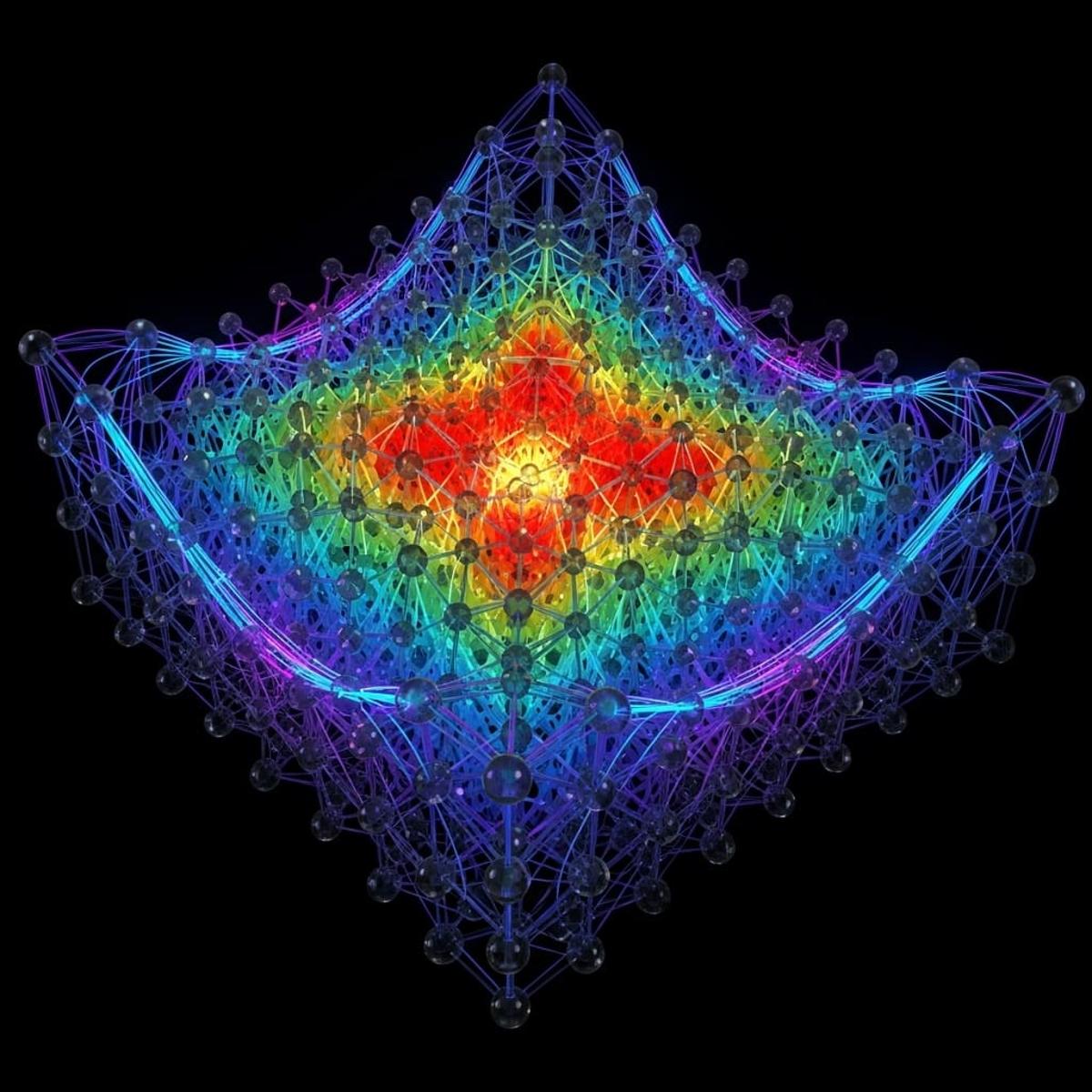
Shows Valley Photonic Crystals Co-Optimise Band Gap and Chern Number Using PSO
•February 4, 2026
0
Why It Matters
Co‑optimising bandgap and topological protection enables photonic circuits that retain high transmission despite defects, accelerating integrated optical technologies. The gradient‑free PSO approach offers a scalable path for designing manufacturable topological photonic devices.
Key Takeaways
- •Modified PSO co‑optimises bandgap and valley Chern number
- •Six‑parameter unit‑cell design explored via gradient‑free optimization
- •Full‑wave FDTD simulations confirm low‑bend loss waveguides
- •Topological figure of merit balances usable gap and protection
- •Approach compatible with standard dielectric‑slab fabrication processes
Pulse Analysis
Topological photonics has emerged as a promising route to overcome the fragility of conventional on‑chip waveguides, which suffer from back‑reflection at bends and disorder‑induced scattering. Valley photonic crystals exploit inversion‑symmetry breaking to generate sharply peaked Berry curvature at the K and K′ points, creating valley‑Hall edge states that can guide light along domain walls. However, achieving a large usable bandgap while preserving strong valley topology has remained a design bottleneck, limiting practical deployment in dense photonic integrated circuits.
The new framework tackles this bottleneck by embedding a modified particle‑swarm optimisation (PSO) engine within a multi‑objective inverse‑design loop. Each particle encodes six geometric parameters of the unit cell, and the algorithm evaluates both the bulk bandgap (via plane‑wave expansion) and the valley Chern number (through gauge‑invariant Berry‑curvature calculations). A topological figure of merit, T(x)=Δf/f₀²·|Cᵥ|, directly couples bandwidth to topological strength, guiding the swarm toward Pareto‑optimal solutions. This gradient‑free approach efficiently navigates the high‑dimensional, non‑convex landscape, delivering designs that outperform prior VPC implementations in both gap size and edge‑state robustness.
For industry, the significance lies in delivering photonic waveguides that can be fabricated with standard dielectric‑slab processes yet remain tolerant to lithographic variations and sharp bends. The demonstrated low‑bend loss and single‑mode operation open avenues for dense optical interconnects, on‑chip quantum information routing, and compact sensors. Future extensions could incorporate additional constraints such as radiation loss, thermal stability, or integration with active components, turning valley‑topological photonics from a research curiosity into a mainstream engineering toolkit.
Shows Valley Photonic Crystals Co-Optimise Band Gap and Chern Number Using PSO
0
Comments
Want to join the conversation?
Loading comments...