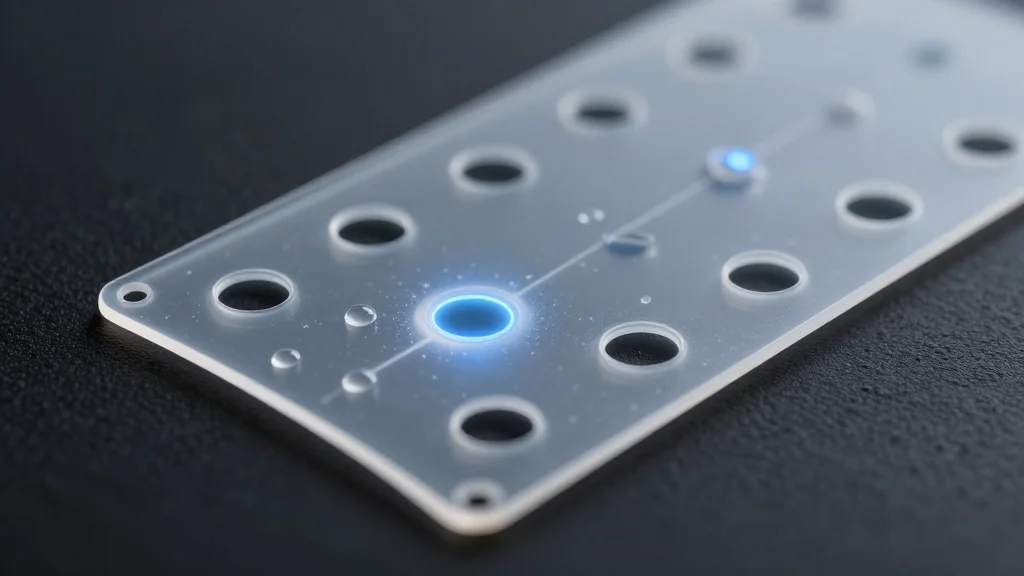
Slippery Ions Create a Smoother Path to Blue Energy
Key Takeaways
- •Lipid bilayer coating creates hydration layer reducing ion friction.
- •Nanopore array yields 15 W m⁻² power density.
- •Performance 2–3× higher than current polymer membranes.
- •Design merges high porosity with precise nanofluidic channels.
- •Approach applicable to broader nanofluidic technologies.
Pulse Analysis
Blue energy, or osmotic power, captures the chemical potential between saltwater and freshwater, offering a steady, low‑carbon electricity source. Traditional polymer membranes excel at ion selectivity but suffer from sluggish ion transport, limiting power output. Conversely, highly porous nanofluidic structures can move ions quickly but often compromise on charge separation and mechanical durability. This trade‑off has kept large‑scale blue‑energy projects in the research phase, prompting scientists to seek materials that can reconcile speed with selectivity without sacrificing robustness.
The EPFL team tackled this dilemma by introducing a biomimetic lubrication strategy. By self‑assembling lipid bilayers inside silicon‑nitride nanopores, they generated a nanometric water film that shields ions from direct surface contact, effectively lowering friction—a phenomenon known as hydration lubrication. Precise control over pore geometry and surface charge, combined with a hexagonal array of 1,000 coated pores, produced a power density of roughly 15 W m⁻² under realistic seawater‑river water gradients. This performance represents a two‑ to three‑fold improvement over the best polymer membranes, demonstrating that ion flux and selectivity can be simultaneously enhanced through surface chemistry engineering.
Beyond immediate energy gains, the study opens pathways for broader nanofluidic applications. The universal nature of hydration lubrication suggests potential upgrades for desalination membranes, biosensors, and micro‑reactors where low‑friction ion transport is critical. Moreover, the scalable fabrication approach—leveraging existing semiconductor processes—could accelerate the transition from laboratory prototypes to commercial blue‑energy modules. Future research will likely focus on long‑term stability, integration with existing power grids, and cost‑effective mass production, positioning nanofluidic blue energy as a viable component of the renewable energy portfolio.
Slippery ions create a smoother path to blue energy
Comments
Want to join the conversation?