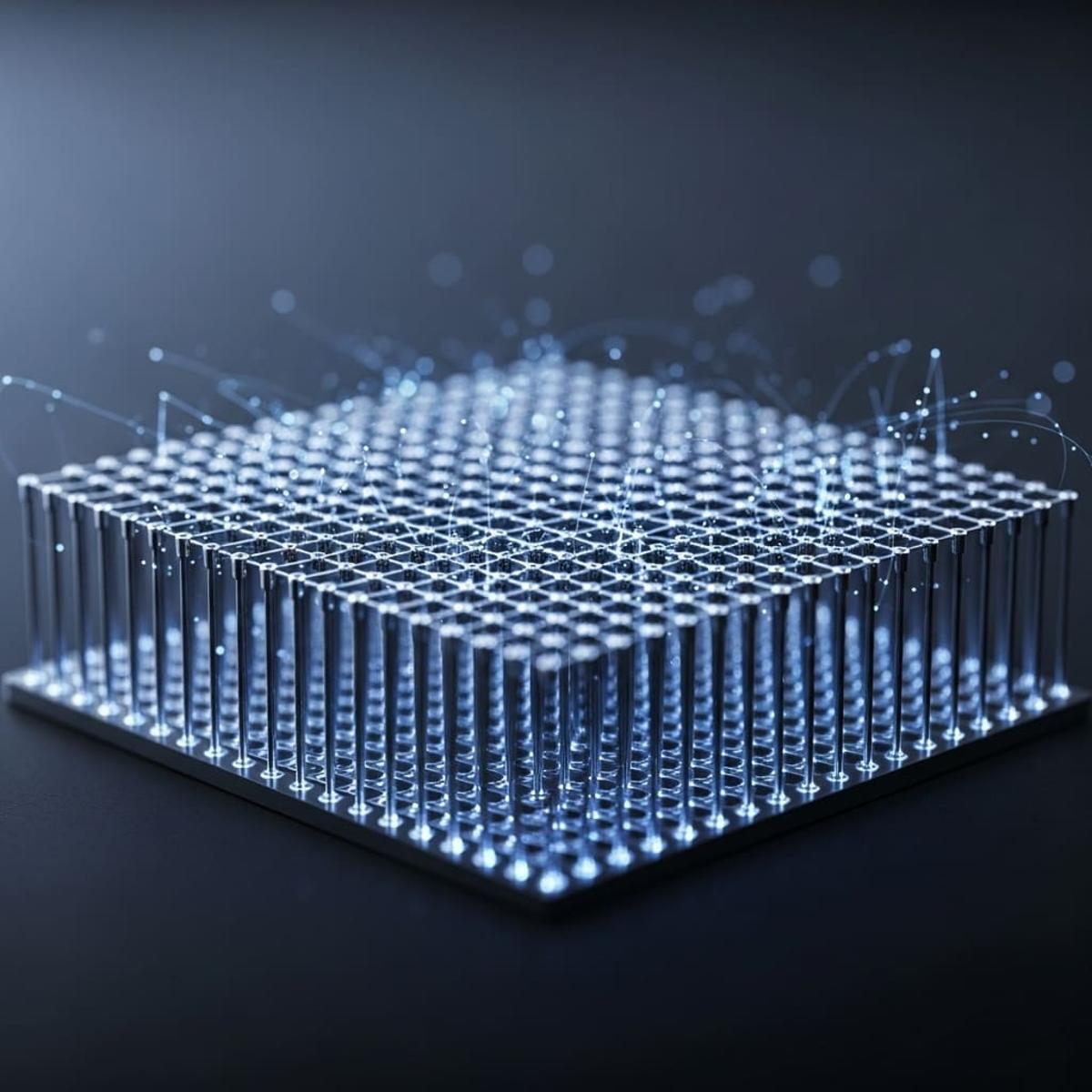
Snspds Achieve Intrinsic Limits with 40% Performance Boost up to 0.1mm
•January 26, 2026
0
Why It Matters
The breakthrough removes the long‑standing performance ceiling of SNSPDs, enabling ultra‑wide, low‑noise photon sensors for quantum communications, biomedical imaging, and deep‑space optics.
Key Takeaways
- •Rails suppress edge current crowding, boosting SNSPD performance
- •Dark-count rate drops by nine orders of magnitude
- •Detection plateau at 1550 nm expands over 40 %
- •Jitter reduced ~30% and efficiency approaches unity for wide strips
Pulse Analysis
Superconducting nanowire single‑photon detectors (SNSPDs) have become the gold standard for low‑light imaging, quantum communication, and time‑correlated photon counting because of their picosecond timing and near‑unity detection efficiency. Yet their performance has been throttled by edge‑current crowding, a geometric effect that forces excess supercurrent to the nanowire borders, raising dark‑count rates and limiting the usable bias window. Decades of material engineering and lithographic refinement have only partially mitigated this issue, leaving a gap between practical devices and the theoretical limits set by the superconducting depairing current.
The NIST‑Caltech team introduced current‑biased superconducting rails flanking the nanowire, creating a compensating magnetic field that flattens the current‑density profile. By tuning the rail current, the edge minimum deepens while the central maximum rises, effectively cancelling the Meissner‑induced crowding predicted by the London equation. Experimental data on 20 µm‑ and 100 µm‑wide WSi strips show a nine‑order‑of‑magnitude reduction in dark counts, a >40 % extension of the 1550 nm detection plateau, and a 30 % jitter improvement, pushing the Isw/Id ratio toward unity.
These results open the door to superconducting strip photon detectors (SSPDs) that can be fabricated at millimetre scales without sacrificing efficiency, enabling large‑area arrays for biomedical imaging, LIDAR, and deep‑space optical links. The ability to tune devices in situ also simplifies system integration, as a single detector can be optimized for different photon energies or operating temperatures. As the quantum‑technology market expands, the rail‑based architecture offers a scalable path to meet the growing demand for ultra‑low‑noise, high‑throughput photon sensors.
Snspds Achieve Intrinsic Limits with 40% Performance Boost up to 0.1mm
0
Comments
Want to join the conversation?
Loading comments...