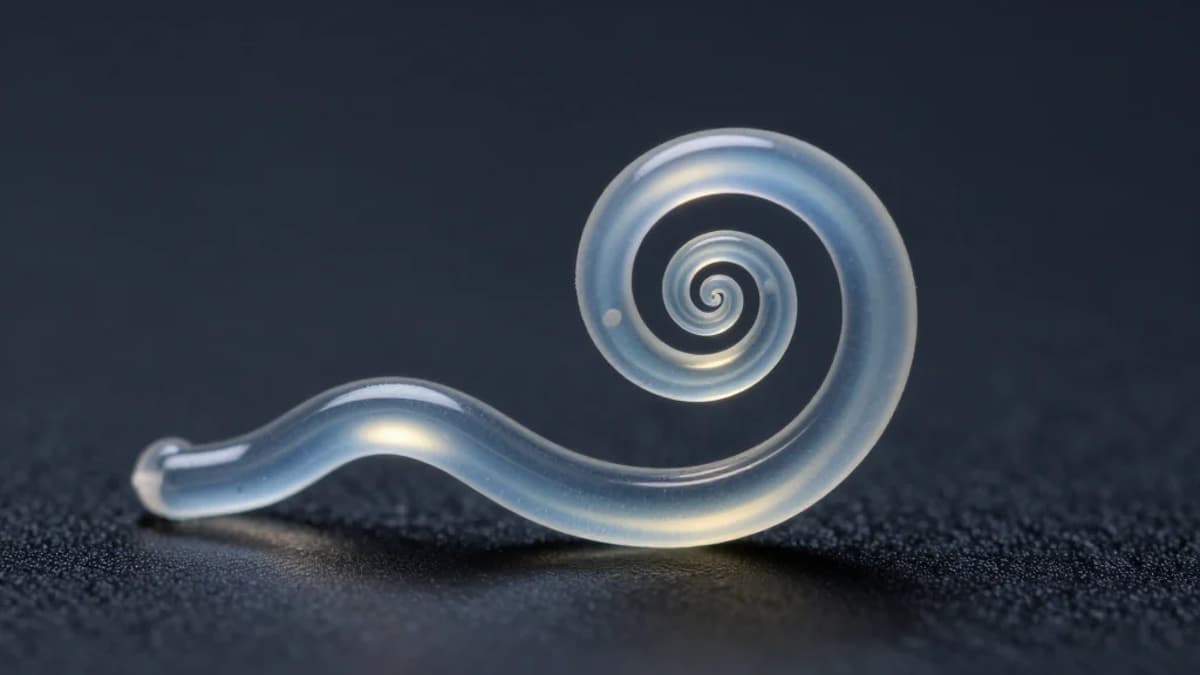
Synthetic Hydrogel Helices Amplify Movement without Muscles or Motors
•March 1, 2026
0
Why It Matters
These helices turn simple hydrogel chemistry into powerful, untethered actuators, opening new pathways for soft robotics, peristaltic pumps, and artificial muscles. The straightforward UV fabrication makes the approach compatible with diverse polymers and scalable manufacturing.
Key Takeaways
- •Gradient-driven swelling converts to amplified helical motion
- •UV photomask + absorber creates tunable density gradients
- •Helix contracts up to 42% axially on heating
- •Self‑oscillating gel achieves 18% axial oscillation without external cues
- •Potential for untethered soft robots and artificial muscles
Pulse Analysis
Nature’s own micro‑motors, from the rapid stalk of Vorticella to the humidity‑driven awns of Erodium seeds, rely on helical architectures that turn tiny local changes into large linear motions. Replicating that principle in synthetic matter has been a long‑standing challenge because it requires a precise, asymmetric swelling profile across a microscopic filament. The new study demonstrates that a simple combination of a helically wrapped UV‑blocking tape and a ruthenium‑based UV absorber can imprint a three‑dimensional polymer density gradient inside a capillary‑filled precursor, causing the gel to curl into a helix once hydrated. This gradient‑driven approach sidesteps the need for multi‑material bonding or complex microfluidic setups, offering a universally adaptable recipe for a wide range of polymer chemistries.
The resulting hydrogel helices exhibit actuation far beyond that of conventional rod‑shaped gels. When heated above the lower‑critical‑solution‑temperature of poly(N‑isopropylacrylamide), the helix contracts 42 % along its axis—more than double the 22 % shrinkage of a straight control—thanks to coupled bending and torsion that tighten the coil. Acidic or near‑infrared stimuli trigger comparable contractions, while embedding a Ru(bpy)₃ catalyst enables autonomous Belousov–Zhabotinsky oscillations with an 18 % axial amplitude, the highest reported for self‑oscillating gels. The ability to tune pitch, diameter, and chirality by adjusting photomask width and spacing adds a design toolbox for bespoke soft actuators.
From an industry perspective, the method’s reliance on standard UV polymerization and commercially available chemicals makes it attractive for scaling to millimeter‑ or centimeter‑scale devices. Potential applications span artificial muscles for wearable exoskeletons, peristaltic pumps that operate without external valves, and untethered soft robots that harvest chemical energy directly from their environment. As the market for soft robotics and bio‑inspired actuation grows, this helical amplification strategy could become a cornerstone technology, driving innovations in medical devices, adaptive optics, and responsive textiles. Future work will likely explore integration with electronic control layers and multi‑stimuli responsive polymers to further broaden functional capabilities.
Synthetic hydrogel helices amplify movement without muscles or motors
0
Comments
Want to join the conversation?
Loading comments...