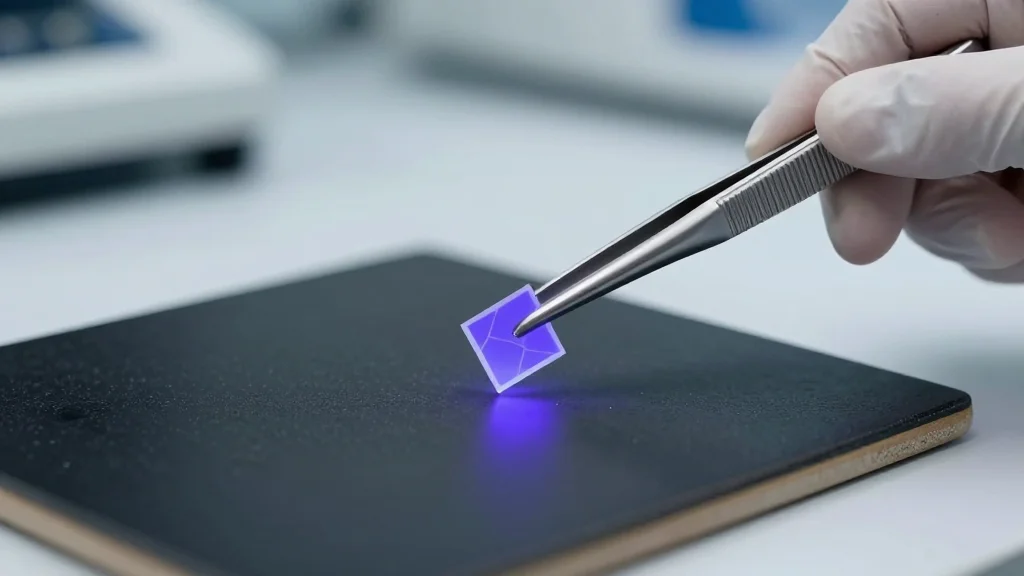
Twisted Boron Nitride Boosts Deep-UV Light Emission for LEDs
Key Takeaways
- •Moiré quantum well boosts deep‑UV LED efficiency 20× over AlGaN.
- •Emission targets 200‑230 nm band safe for continuous disinfection.
- •Twisted hBN layers enable quantum confinement without gallium.
- •Potential to replace mercury lamps in hospitals and transit.
- •POSTECH's breakthrough positions South Korea at UV semiconductor forefront.
Pulse Analysis
The demand for deep‑ultraviolet light sources has surged since the COVID‑19 pandemic, driven by the need for rapid, chemical‑free disinfection. Traditional AlGaN LEDs, while dominant in the visible and near‑UV spectrum, suffer a dramatic efficiency drop below 240 nm, limiting their usefulness in the 200‑230 nm band where photons can inactivate pathogens without penetrating human skin. This efficiency gap has forced many industries to rely on mercury‑based lamps, which pose environmental and health concerns.
POSTECH's innovation leverages the unique properties of van der Waals materials. By rotating and stacking hBN layers at a precise twist angle, researchers generate a moiré pattern that creates a quantum‑well capable of trapping electrons within a nanometer‑scale region. This confinement dramatically enhances radiative recombination, producing deep‑UV photons with an efficiency twenty times higher than AlGaN counterparts. The approach sidesteps the need for gallium, simplifying material synthesis and opening new pathways for three‑dimensional quantum‑engineered devices.
If scaled to commercial production, these high‑efficiency deep‑UV LEDs could replace legacy mercury lamps across hospitals, schools, public transit, and water‑treatment facilities, enabling continuous, safe sterilization. The technology also positions South Korea as a leader in next‑generation optoelectronics, attracting further investment from both government programs and private semiconductor firms. Ongoing research aims to integrate the moiré quantum wells into robust device architectures, potentially extending the concept to other wavelength regimes and quantum photonic applications.
Twisted boron nitride boosts deep-UV light emission for LEDs
Comments
Want to join the conversation?