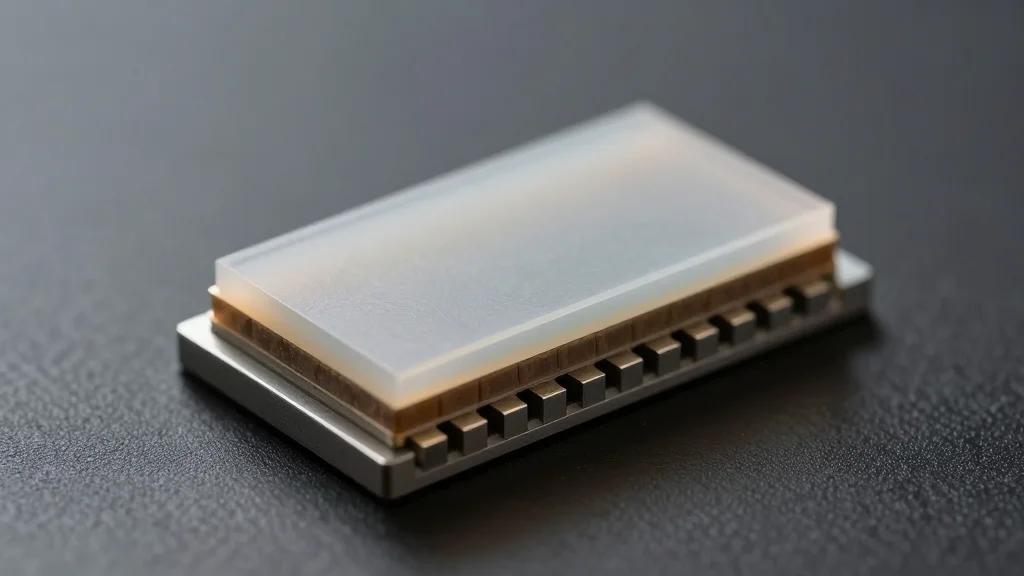
25‑nm Ferroelectric Memory Chip Beats Power‑Loss Limits, Paving Way for Cooler AI Devices

Why It Matters
The ability to shrink memory cells while simultaneously lowering power consumption directly addresses two of the semiconductor industry's most pressing challenges: the end of Moore's Law scaling and the soaring energy demand of AI workloads. By leveraging a material already entrenched in the supply chain, the breakthrough reduces the barrier to adoption, potentially accelerating the rollout of ultra‑dense, low‑heat memory across a spectrum of products. Beyond immediate efficiency gains, the technology could reshape the economics of edge computing. Devices that previously required frequent battery replacements or active cooling could become truly autonomous, expanding the viable use cases for remote sensing, medical wearables, and distributed AI inference. In a market where every milliwatt counts, a memory architecture that gets better as it gets smaller could become a new cornerstone of future hardware design.
Key Takeaways
- •Scientists at Institute of Science Tokyo built a 25‑nm ferroelectric tunnel junction memory cell.
- •The device uses hafnium oxide, discovered in 2011 to retain ferroelectricity at atomic scales.
- •Performance improves as the chip shrinks, overturning a decades‑old scaling assumption.
- •No new manufacturing infrastructure is required; hafnium oxide is already used in fabs.
- •Prototype could reach volume production by late 2027, targeting AI, wearables and sensors.
Pulse Analysis
The 25‑nm FTJ breakthrough arrives at a moment when the semiconductor industry is scrambling for alternatives to pure transistor scaling. Historically, ferroelectric memories have been relegated to niche applications because leakage and variability made them unsuitable for mass production. By marrying a well‑established high‑k material with a clever electrode geometry, Science Tokyo has effectively removed the two biggest technical roadblocks.
From a market perspective, the timing aligns with the surge in AI model sizes and the corresponding demand for memory that can keep up without exploding power budgets. Data‑center operators are already investing heavily in cooling infrastructure; a memory technology that reduces heat at the source could shift capital expenditures from HVAC to compute capacity. Moreover, the compatibility with existing CMOS lines means that foundries can adopt the process without the massive capex associated with new lithography nodes, making the economics more attractive for both legacy and emerging players.
Looking ahead, the key question will be whether the heating‑induced electrode shaping can be reliably reproduced at wafer scale. If the technique proves robust, we may see a cascade of design revisions where FTJ memory replaces conventional SRAM or DRAM in power‑sensitive blocks. That would not only extend battery life for billions of consumer devices but also enable new form factors where heat dissipation has been a limiting factor. The next six to twelve months, when pilot production ramps up, will be decisive in determining whether this laboratory marvel becomes a commercial staple or remains a fascinating proof of concept.
25‑nm Ferroelectric Memory Chip Beats Power‑Loss Limits, Paving Way for Cooler AI Devices
Comments
Want to join the conversation?
Loading comments...