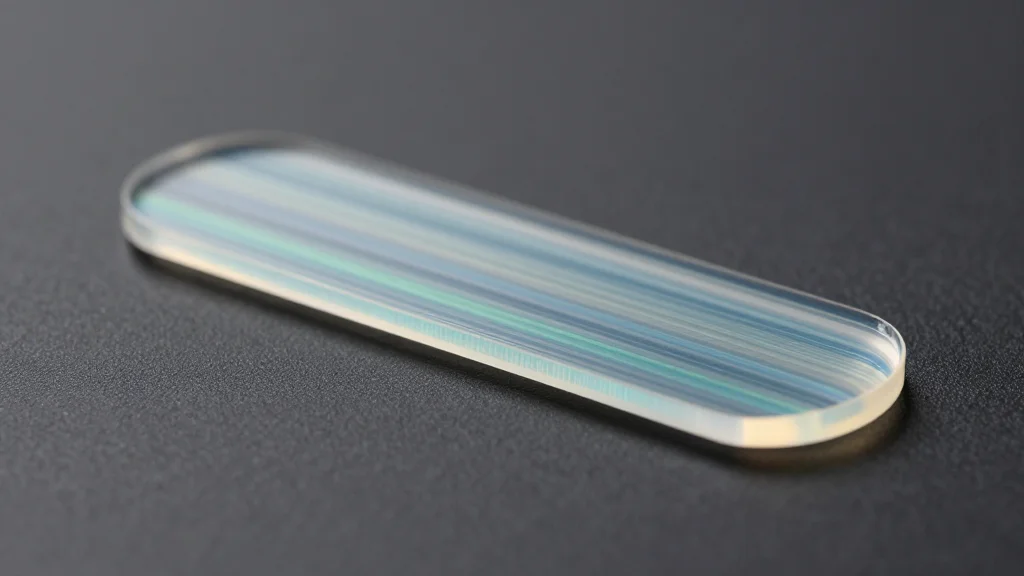
3D Printed Polymers Gain Ordered Nanostructures During Fabrication
Key Takeaways
- •PIANO resin enables nanostructure ordering within 30–60 seconds during printing.
- •Ethylene glycol acts as temporary mobility mediator, delaying permanent crosslinking.
- •Post‑print thermal annealing locks structures, boosting tensile strength fivefold.
- •Formulation tweaks switch morphology between lamellar layers and hexagonal cylinders.
- •Multiscale control achieved without hardware changes, only resin chemistry adjustments.
Pulse Analysis
Additive manufacturing has long excelled at shaping external geometries, yet internal architecture—critical for heat, ion, or light transport—remains elusive. The PIANO method tackles this by decoupling chain mobility from network formation, allowing block copolymers to self‑assemble while the part is still being printed. This kinetic window, opened by ethylene glycol acting as a reversible mobility mediator, enables ordered lamellar or hexagonal domains to emerge in under a minute, a dramatic speedup compared with traditional solvent or thermal annealing processes. The result is a hierarchically structured material that retains the design freedom of 3D printing.
Experimental validation combined small‑angle X‑ray scattering, electron microscopy, and tensile testing on parts printed with a commercial LCD printer. Researchers demonstrated that domain spacings of 20–60 nm could be reliably reproduced across printed volumes, and that a simple 100 °C post‑cure step formed ester crosslinks, converting the temporary hydrogen‑bonded network into a robust covalent matrix. This annealing step increased tensile strength roughly fivefold without causing shrinkage, confirming that nanoscale order and macroscopic dimensions can coexist after processing. Formulation adjustments—such as polymer precursor length—served as a dial to switch between lamellar and cylindrical morphologies, offering designers a chemical toolkit for tailoring internal pathways.
The implications for industry are significant. Materials with built‑in nanostructured channels could improve thermal management in high‑performance electronics, enhance ion transport in solid‑state batteries, or provide directional stiffness in lightweight aerospace components. Because the technique relies on resin chemistry rather than printer upgrades, it can be adopted across existing additive‑manufacturing lines, accelerating time‑to‑market for advanced functional parts. As the demand for multifunctional printed devices grows, PIANO positions itself as a scalable bridge between macro‑fabrication and nanoscale engineering, likely spurring further investment in smart resin development.
3D printed polymers gain ordered nanostructures during fabrication
Comments
Want to join the conversation?