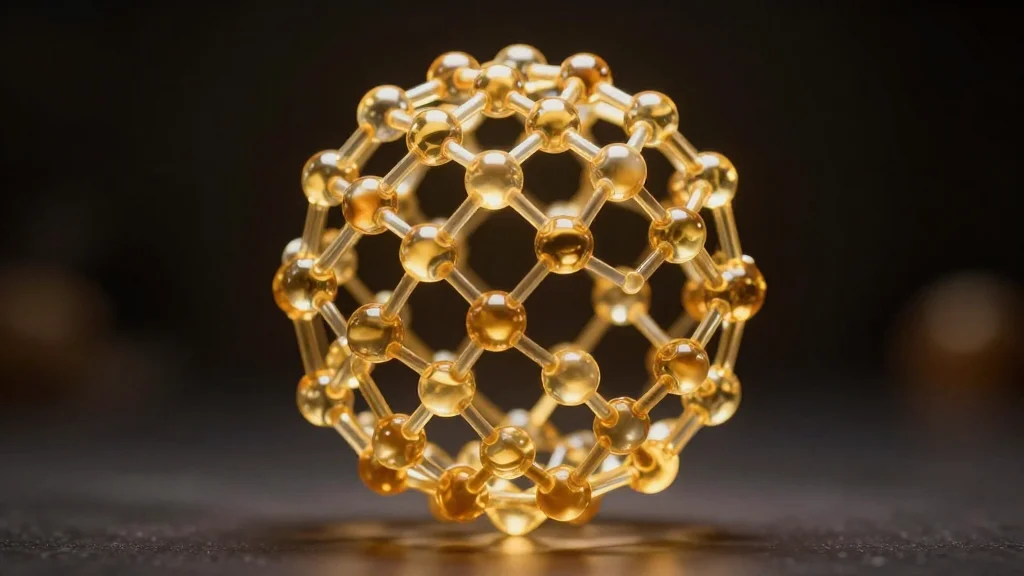
80-Atom Boron 'Buckyball' Finally Steps Into Nanotechnology's Spotlight
Why It Matters
A stable B₈₀ fullerene could expand the toolbox of nanomaterials, enabling new electronic, catalytic, and energy‑storage applications beyond what carbon allotropes offer.
Key Takeaways
- •Brown team confirms B₈₀ buckyball via photoelectron spectroscopy.
- •Spectral peaks indicate high symmetry and unexpected stability.
- •DFT predicts instability, but experimental data challenges the model.
- •Potential for boron nanostructures to complement carbon in electronics.
- •Bulk synthesis remains uncertain; reactivity in ambient conditions unknown.
Pulse Analysis
The discovery of a stable B₈₀ fullerene marks the first experimental verification of a boron analogue to the iconic C₆₀ buckminsterfullerene. Using laser‑ablated boron targets and photoelectron spectroscopy, a Brown University team captured a distinct electron‑binding‑energy fingerprint that matches the highly symmetric cage predicted by theory. While carbon’s versatile allotropes—fullerenes, nanotubes, graphene—have driven decades of nanotech innovation, boron’s electron‑deficient chemistry has long limited its ability to form closed‑shell structures. This breakthrough demonstrates that boron can adopt a spherical geometry comparable to carbon, opening a new class of nanomaterials.
The experimental spectra contradict prevailing density‑functional theory, which has consistently flagged B₈₀ as unstable due to strained bond lengths. By cross‑checking the photoelectron peaks with international collaborators, Wang’s group argues that current DFT parametrizations misrepresent boron‑boron interactions in highly curved cages. This discrepancy not only forces a reassessment of computational methods for electron‑deficient elements but also hints at unique electronic properties—such as altered band gaps and enhanced chemical reactivity—that could surpass carbon fullerenes in catalysis or energy storage. Early parallels with borophene suggest that scalable synthesis may follow a similar rapid trajectory.
Commercializing B₈₀ will require overcoming two hurdles: bulk production and ambient stability. The laser‑ablation method yields only minute quantities under vacuum, and preliminary observations indicate the cages may oxidize quickly when exposed to air. If researchers can functionalize the surface or embed the clusters in protective matrices, the material could find niche roles in quantum‑dot displays, high‑capacity batteries, or as a scaffold for drug delivery—areas where carbon fullerenes already have a foothold. Wang’s optimism, citing the two‑year leap from boron disks to borophene, suggests that focused investment could accelerate the path from laboratory curiosity to market‑ready technology.
80-atom boron 'buckyball' finally steps into nanotechnology's spotlight
Comments
Want to join the conversation?
Loading comments...