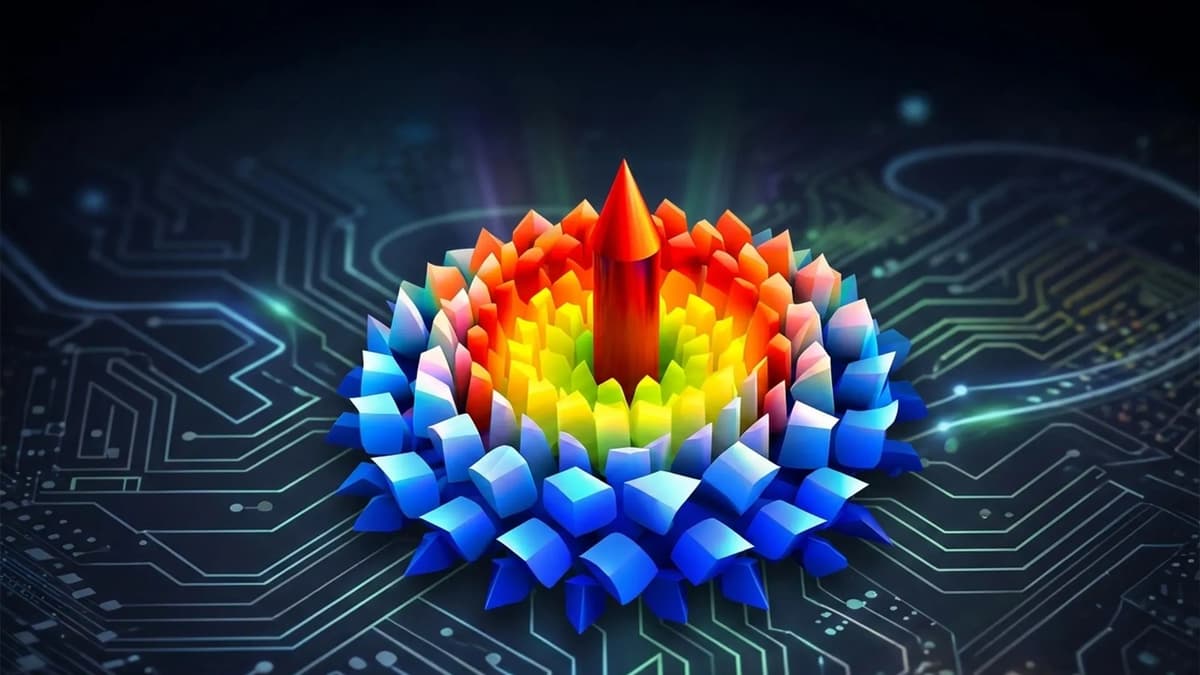
A Tiny Twist Creates Giant Magnetic Skyrmions in 2D Crystals
•March 2, 2026
0
Why It Matters
The finding proves twist angle can directly control magnetic topology, opening a simple, energy‑efficient pathway to skyrmion‑based devices and advancing post‑CMOS computing technologies.
Key Takeaways
- •Twist angle tunes antiferromagnetic skyrmion size.
- •Maximal skyrmions appear near 1.1° twist.
- •Skyrmions span hundreds of nanometers across moiré cells.
- •Geometry-driven creation avoids lithography and heavy metals.
- •Enables low‑power, topologically protected spintronic devices.
Pulse Analysis
Moiré engineering has reshaped the landscape of two‑dimensional materials by exploiting tiny rotational mismatches to tailor electronic bands. While most studies focused on superconductivity or correlated insulators, the latest research extends this paradigm to magnetism, demonstrating that a mere few‑degree twist can reorganize spin textures far beyond the atomic lattice. This breakthrough underscores the versatility of twist‑controlled heterostructures, positioning them as a universal platform for emergent quantum phenomena.
In the reported work, twisted antiferromagnetic bilayers develop extended Néel‑type skyrmions that occupy multiple moiré cells, a phenomenon the authors label "super‑moiré spin order." Large‑scale spin‑dynamics simulations reveal that decreasing the twist angle enlarges the moiré period but paradoxically compresses the magnetic texture until a sweet spot near 1.1°, where skyrmion diameter reaches several hundred nanometers. The interplay of exchange coupling, magnetic anisotropy and Dzyaloshinskii‑Moriya interaction—each subtly tuned by the interlayer rotation—drives this counterintuitive size evolution, challenging the assumption that magnetic patterns merely echo the moiré template.
From a technology standpoint, these geometry‑induced skyrmions are attractive for spintronic circuits. Their topological protection ensures stability, while their larger footprint simplifies detection and manipulation with modest electric currents. Crucially, the twist‑only fabrication eliminates the need for heavy‑metal layers or complex lithography, promising ultra‑low‑power operation in insulating hosts. As the industry seeks energy‑efficient alternatives to conventional CMOS, such twist‑engineered topological magnets could become foundational components in next‑generation memory and logic architectures, spurring further exploration of angle‑controlled quantum materials.
A tiny twist creates giant magnetic skyrmions in 2D crystals
0
Comments
Want to join the conversation?
Loading comments...