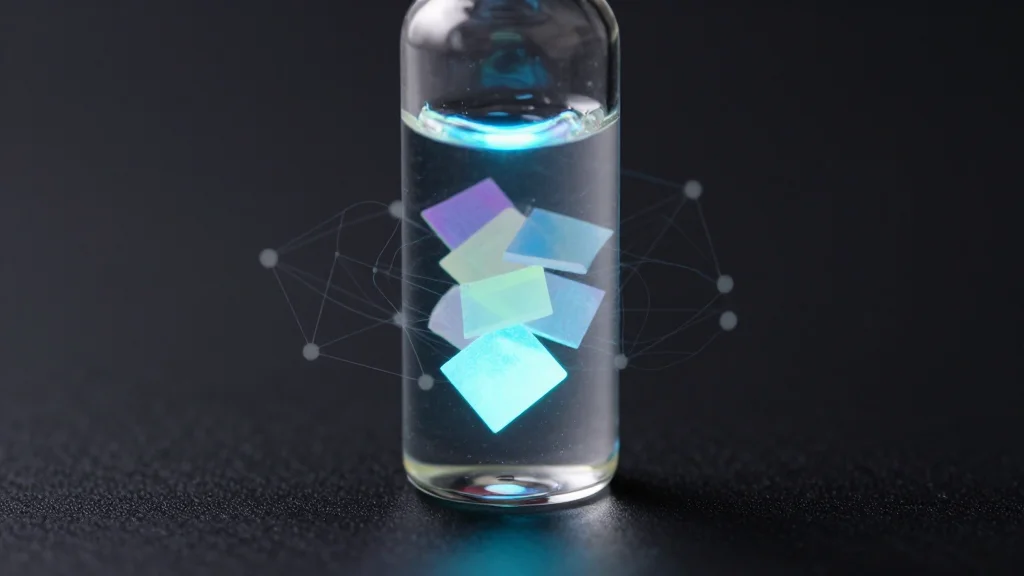
AI-Powered Lab Discovers Brighter Lead-Free Nanomaterials in 12 Hours
Why It Matters
The breakthrough slashes material discovery cycles from years to hours, enabling faster commercialization of safer optoelectronic components for energy and electronics markets. It also showcases a scalable model for AI‑human‑robot collaboration that can be applied to other complex material systems.
Key Takeaways
- •PoLARIS completed 120 experiments in 12 hours
- •Identified brightest lead‑free double perovskite nanoplatelets
- •AI loop learns, maps chemistry‑temperature‑performance relationships
- •System can switch from discovery to continuous production
- •Accelerates safe optoelectronic material development for energy tech
Pulse Analysis
The rise of autonomous laboratories marks a turning point in materials science, where AI and microfluidics converge to replace traditional trial‑and‑error. PoLARIS exemplifies this shift by integrating syringe‑pump‑driven flow reactors, in‑line spectroscopic analysis, and a reinforcement‑learning algorithm that continuously refines synthesis recipes. Within a single 12‑hour campaign, the platform explored a vast chemical space, delivering a best‑in‑class lead‑free perovskite nanoplatelet that outperforms previous benchmarks in photoluminescence intensity.
Beyond the technical feat, the discovery of brighter, lead‑free double perovskites carries significant commercial implications. Safer optoelectronic materials are in high demand for photodetectors, display technologies, and emerging solar‑fuel converters, where regulatory pressure to eliminate toxic heavy metals is intensifying. By dramatically shortening the R&D timeline, PoLARIS enables companies to bring compliant, high‑performance products to market faster, potentially capturing early‑mover advantage in sectors ranging from consumer electronics to renewable energy.
Looking ahead, the scalability of PoLARIS suggests a broader transformation in how complex materials are engineered. The platform’s ability to pivot from discovery to continuous manufacturing creates a seamless pipeline from lab to fab, reducing capital expenditures associated with scale‑up. As venture capital and corporate R&D invest more in AI‑driven synthesis, we can expect a proliferation of similar self‑driving labs targeting batteries, catalysts, and quantum materials, accelerating the overall pace of innovation while deepening scientific understanding of multi‑parameter chemical systems.
AI-powered lab discovers brighter lead-free nanomaterials in 12 hours
Comments
Want to join the conversation?
Loading comments...