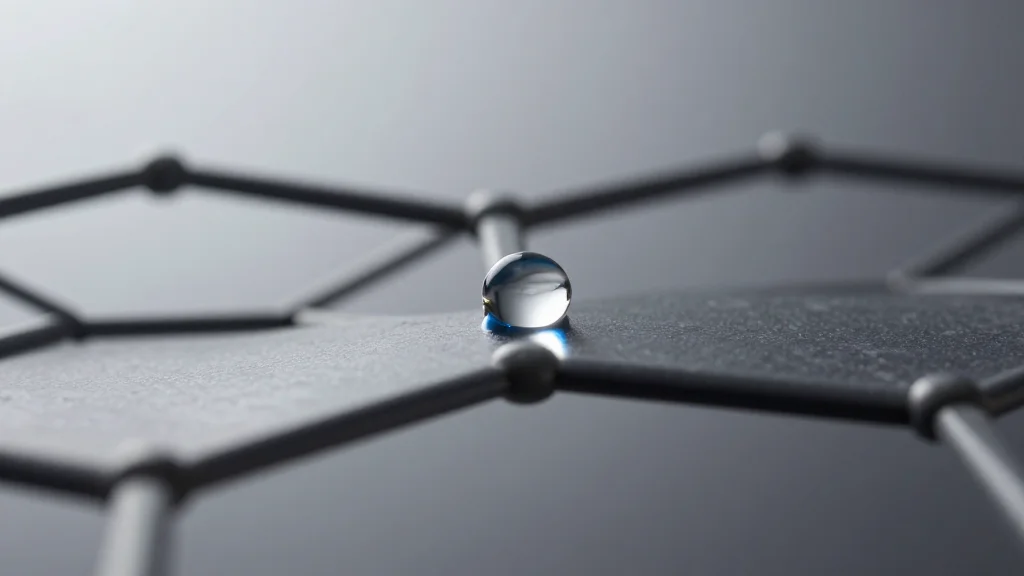
AI Simulations Prove Pristine Graphene Is Intrinsically Hydrophobic, Settling Decade‑Long Debate

Why It Matters
Resolving graphene’s wetting behavior removes a major uncertainty that has hampered the scaling of graphene‑based components in water‑sensitive applications. Designers of membranes, sensors, and energy devices can now model performance with confidence, reducing costly trial‑and‑error cycles. Moreover, the successful use of AI‑augmented molecular dynamics sets a precedent for tackling other contentious material properties, potentially shortening the path from laboratory discovery to commercial product. Beyond graphene, the methodology demonstrates that machine learning can bridge gaps between theory and experiment, especially when experimental conditions are difficult to control. This could accelerate the validation of novel nanomaterials, fostering faster innovation across the broader nanotech ecosystem.
Key Takeaways
- •IBS team led by Cho Minhaeng and Stefan Ringle used AI‑based molecular dynamics to study graphene‑water interactions.
- •Simulations showed dangling O‑H bonds on pristine graphene, confirming intrinsic hydrophobicity.
- •Hydrophobicity increases with the number of graphene layers; multilayer samples repel water more strongly.
- •Trapped water beneath single‑layer graphene on hydrophilic substrates explains previous contradictory results.
- •Findings published in Nature Communications on April 2, 2026, will impact nano‑fluidics, desalination, energy storage, and fuel cells.
Pulse Analysis
The confirmation of graphene’s intrinsic hydrophobicity is more than a scientific footnote; it reshapes the economic calculus for companies betting on graphene‑based products. Firms that have postponed large‑scale membrane projects due to uncertainty over water interaction can now proceed with clearer risk assessments, potentially unlocking billions in market value for water purification and desalination technologies. Conversely, startups that have built business models around graphene’s presumed hydrophilicity may need to pivot, adjusting their IP portfolios and product roadmaps.
Historically, the graphene debate highlighted the limits of conventional experimental techniques when dealing with atomically thin materials. The AI‑driven approach sidesteps many of those constraints by simulating the exact atomic environment, offering a reproducible and scalable pathway to answer other contentious questions—such as graphene’s edge chemistry or defect‑mediated conductivity. This could catalyze a wave of AI‑first research labs, where computational validation precedes costly fabrication.
Looking ahead, the next frontier will be integrating these insights into multi‑physics device simulations that couple fluid dynamics, electrochemistry, and mechanical stress. If AI can reliably predict interfacial behavior across material families, the nanotech industry may experience a shift from empirical iteration to predictive engineering, compressing development timelines from years to months. Investors and policymakers should watch for emerging platforms that commercialize this AI‑simulation capability, as they are likely to become strategic assets in the race to dominate next‑generation nanomanufacturing.
AI Simulations Prove Pristine Graphene Is Intrinsically Hydrophobic, Settling Decade‑Long Debate
Comments
Want to join the conversation?
Loading comments...