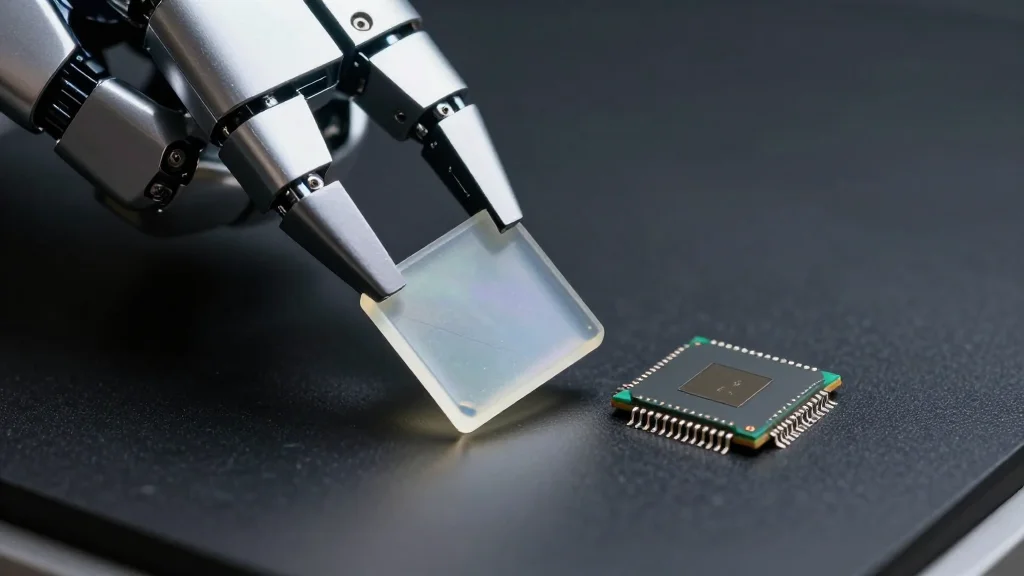
AI System Qumus Autonomously Creates Graphene Flake and First AI‑Built Graphene FET

Why It Matters
Qumus bridges the gap between generative AI and hands‑on nanofabrication, turning abstract design into physical devices without human intervention. This capability could democratize access to high‑quality graphene devices, allowing research groups without extensive clean‑room infrastructure to prototype advanced electronics. Moreover, the systematic metadata capture creates a rich dataset for further machine‑learning models, potentially leading to self‑optimizing fabrication pipelines that continuously improve yield and performance. In the broader nanotech ecosystem, autonomous labs could reshape supply chains for 2D materials, reducing dependence on specialized technicians and shortening time‑to‑market for emerging applications such as flexible displays, high‑frequency transistors and quantum sensors. The convergence of AI, robotics and materials science heralds a shift from manual, trial‑and‑error experimentation to data‑driven, high‑throughput manufacturing.
Key Takeaways
- •Qumus AI system isolated a 245 µm² graphene flake after five optimization cycles.
- •The system fabricated a graphene field‑effect transistor in a 90‑minute dry‑transfer sequence.
- •30 physical operations and 18 AI‑controlled decision points were executed during device assembly.
- •Full workflow from bulk crystal to functional device completed in about 1.5 hours of robotic processing.
- •Team includes Princeton, Michigan, California State University and Japan's NIMS.
Pulse Analysis
The Qumus breakthrough illustrates a pivotal inflection point where AI moves from design assistance to full experimental execution in nanotechnology. Historically, graphene research has been hampered by the painstaking manual steps required to locate and transfer atomically thin flakes. By embedding LLM‑driven agents within a closed‑loop robotic platform, Qumus eliminates the most time‑consuming human interventions, effectively turning a weeks‑long process into a matter of hours. This acceleration could compress the R&D timelines for graphene‑based transistors, making them more competitive against silicon in niche high‑frequency or flexible applications.
From a market perspective, the technology lowers the barrier to entry for startups and academic labs lacking extensive clean‑room facilities. If the cost of a Qumus‑style mini‑lab can be amortized across multiple projects, we may see a proliferation of AI‑driven nanofabrication services, akin to cloud‑based compute platforms today. However, scaling the system will require addressing yield variability and ensuring that AI decision‑making remains robust across different material batches. The next logical step—integrating in‑situ electrical testing—will transform the platform from a purely manufacturing tool into a closed‑loop discovery engine, where performance feedback directly informs subsequent fabrication cycles.
In the longer term, the Qumus architecture could be adapted to other emerging 2D materials, enabling rapid prototyping of heterostructures that combine graphene with semiconducting layers like MoS₂. Such capabilities would accelerate the development of van der Waals heterostructure devices, a frontier that promises ultra‑thin, low‑power electronics. The convergence of AI, robotics and materials science embodied by Qumus therefore not only solves a specific technical challenge but also sets a template for the next generation of autonomous nanotech laboratories.
AI System Qumus Autonomously Creates Graphene Flake and First AI‑Built Graphene FET
Comments
Want to join the conversation?
Loading comments...