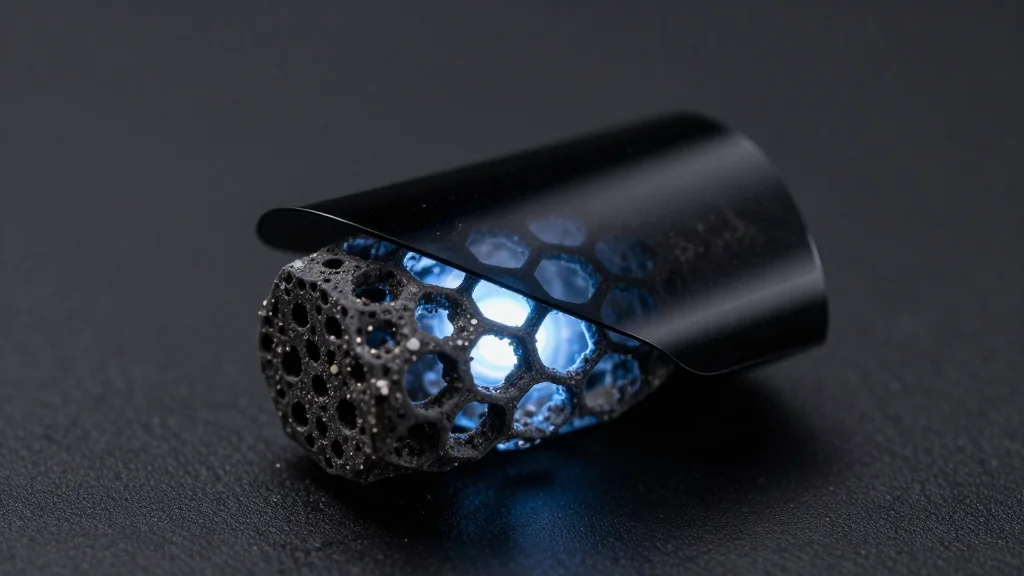
Alkynyl‐Bipyridine–Based Conjugated Microporous Polymer Anode for Lithium Storage
Why It Matters
The breakthrough pushes CMP anodes toward practical lithium‑ion batteries, offering energy densities rivaling conventional graphite while maintaining structural stability. It signals a viable path for high‑capacity, long‑life storage materials in electric‑vehicle and grid applications.
Key Takeaways
- •Alk-Bpy-CMP delivers 674 mAh g⁻¹ at 0.1 A g⁻¹ after 100 cycles.
- •rGO encapsulation raises capacity to 1,020 mAh g⁻¹ over 200 cycles.
- •Hexagonal pores provide uniform lithium diffusion pathways.
- •Bipyridine and alkynyl linkages act as high‑density storage sites.
- •Performance approaches theoretical limit of 1,145 mAh g⁻¹.
Pulse Analysis
Conjugated microporous polymers (CMPs) have long intrigued battery researchers because their extended π‑conjugated frameworks can host abundant lithium‑binding sites. Yet, most CMPs suffer from poor electrical conductivity and ill‑defined pore architectures, limiting practical capacity and rate performance. By integrating sp‑ and sp2‑hybridized alkynyl linkages with bipyridine units, the Alk‑Bpy‑CMP achieves a uniform hexagonal pore network that facilitates rapid ion transport while preserving a high density of electroactive sites. This structural precision addresses a key bottleneck in the field, positioning CMPs as credible competitors to traditional graphite anodes.
The addition of reduced graphene oxide (rGO) creates a conductive shell around the polymer particles, dramatically lowering charge‑transfer resistance. This synergy lifts the specific capacity from 674 mAh g⁻¹ to 1,020 mAh g⁻¹ after 200 cycles at a modest current density, edging close to the theoretical ceiling of 1,145 mAh g⁻¹. Such numbers surpass most reported CMP‑based anodes and rival emerging silicon‑based designs, but with the added benefit of structural robustness that supports over 1,000 charge‑discharge cycles without significant degradation.
From a market perspective, the high energy density and longevity of Alk‑Bpy‑CMP@rGO could accelerate the adoption of next‑generation lithium‑ion batteries in electric vehicles and stationary storage, where every extra watt‑hour per kilogram translates to longer range or reduced system cost. Moreover, the scalable synthesis route—leveraging well‑established organic coupling reactions—makes industrial translation plausible. Future work will likely explore electrolyte optimization and hybrid electrode architectures to further exploit the material’s fast kinetics, potentially unlocking even higher power capabilities while maintaining its impressive capacity ceiling.
Alkynyl‐Bipyridine–Based Conjugated Microporous Polymer Anode for Lithium Storage
Comments
Want to join the conversation?
Loading comments...