Key Takeaways
- •Quantum metric experimentally observed at oxide interface.
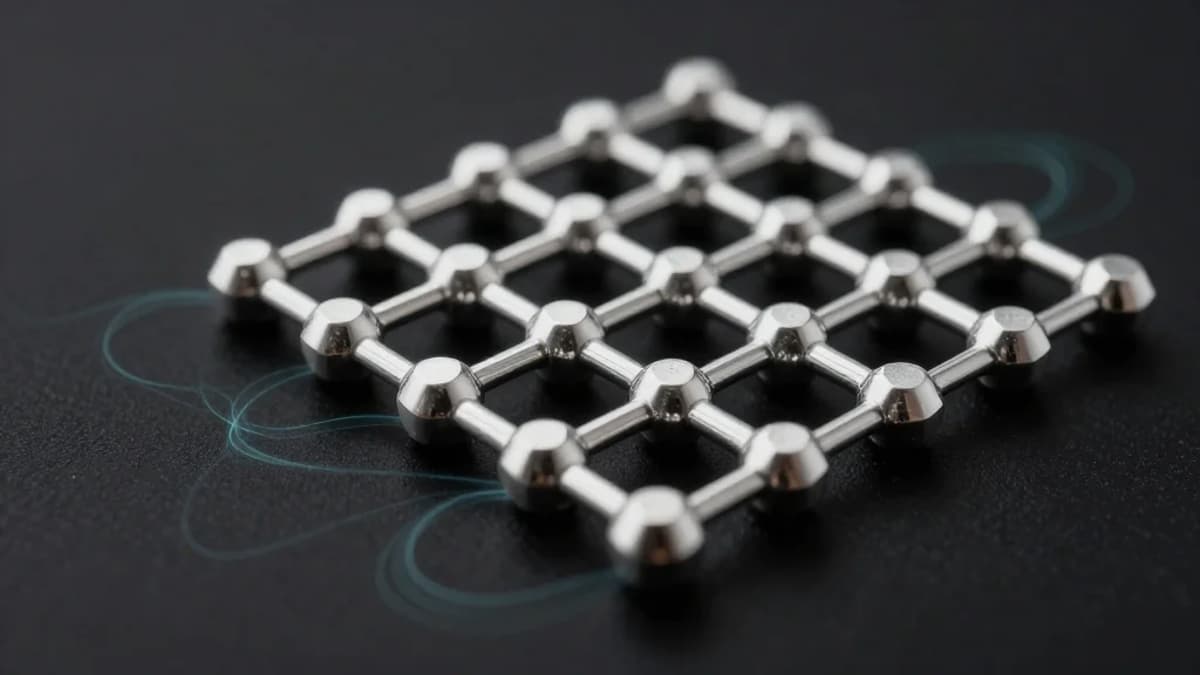
- •Geometry distorts electron paths like gravitational lensing.
- •Findings enable precise tuning of optical and transport properties.
- •Intrinsic quantum metric present in many materials, not rare.
- •Potential to boost terahertz electronics, superconductivity, light‑matter coupling.
Summary
Researchers from the University of Geneva, the University of Salerno and CNR‑SPIN have directly detected the quantum metric—a geometric property of electron wavefunctions—at the interface of strontium titanate and lanthanum aluminate, as reported in Science (Aug 2025). The quantum metric, previously only a theoretical construct, was shown to bend electron trajectories under strong magnetic fields, analogous to how gravity bends light. This observation confirms that quantum geometry is an intrinsic feature of many quantum materials. The work opens pathways for designing terahertz‑frequency electronics, superconductors and advanced light‑matter devices.
Pulse Analysis
The concept of quantum geometry has lingered in theoretical physics for two decades, describing how the curvature of an abstract quantum space influences particle behavior. While mathematicians have long modeled this curvature as a "quantum metric," experimental verification remained elusive, limiting its practical relevance. Recent advances in high‑resolution spectroscopy and ultra‑clean oxide interfaces have finally bridged the gap between theory and observation, positioning quantum metric as a tangible material parameter.
In the breakthrough study, the Geneva‑Salerno team probed the SrTiO₃/LaAlO₃ interface under intense magnetic fields, tracking subtle deviations in electron trajectories. By correlating these deviations with predictions from quantum‑metric theory, they demonstrated a direct, measurable impact of geometric curvature on charge transport. This methodology not only validates a long‑standing hypothesis but also equips researchers with a diagnostic tool to map quantum‑metric signatures across diverse material platforms, from topological insulators to unconventional superconductors.
Looking ahead, the ability to harness quantum metric could revolutionize device engineering. Precise control over electron pathways promises terahertz‑band transistors with minimal energy loss, while the intrinsic link between geometry and pairing mechanisms may unlock higher‑temperature superconductors. Moreover, tailoring light‑matter interactions via quantum‑metric modulation could enhance photonic circuits and quantum information processors. As industry seeks ever‑faster, more efficient technologies, quantum geometry is poised to become a cornerstone of next‑generation material design.
Comments
Want to join the conversation?