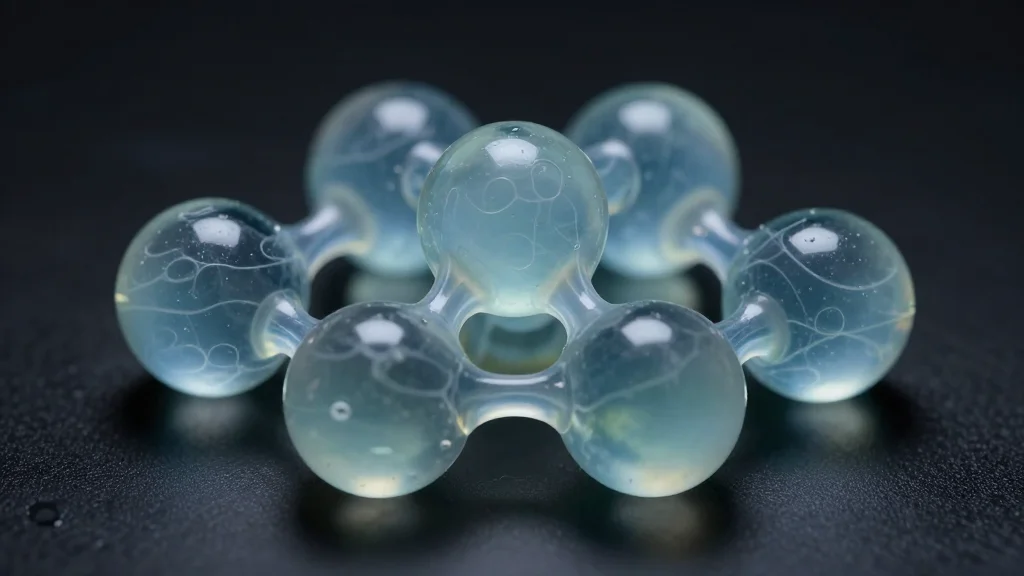
Bottom‐Up Assembly of Amorphous Metal–Organic Frameworks From Proton Conductive Metal–Organic Polyhedra
Why It Matters
The method provides a scalable route to highly conductive, proton‑conducting aMOFs, opening new avenues for fuel‑cell membranes and other energy‑conversion technologies.
Key Takeaways
- •MOPs serve as modular nodes preserving functionality in amorphous networks
- •Crosslinking with flexible ditopic linkers tunes free volume and conductivity
- •Proton conductivity reaches 4.8 mS cm⁻¹ at 85 °C, 90 % RH
- •Sulfonate‑free analogs become insulating, confirming sulfonate’s role
- •Bottom‑up design offers scalable route versus top‑down amorphization
Pulse Analysis
Amorphous metal‑organic frameworks have lagged behind their crystalline counterparts because researchers lack precise control over their internal architecture. Traditional top‑down amorphization strips away the ordered lattice, often sacrificing functional sites essential for applications such as ion transport. By contrast, the bottom‑up assembly described here leverages metal‑organic polyhedra—discrete, pre‑designed clusters—as building blocks, preserving node‑level chemistry while allowing the network to remain non‑crystalline. This strategy bridges the gap between structural programmability and the inherent flexibility of amorphous materials, a combination increasingly sought after in advanced membrane design.
The study focuses on rhodium‑based MOPs enriched with sulfonate groups, which act as intrinsic proton‑donor sites. These MOPs feature axial coordination positions that can be linked with a variety of ditopic organic linkers, creating an extended amorphous matrix. By swapping linkers, researchers tuned the free volume and water uptake, directly influencing proton mobility. The resulting aMOFs demonstrated a record‑high conductivity of 4.8 mS cm⁻¹ at 85 °C and 90 % relative humidity, with a low activation energy of 0.20 eV—metrics comparable to leading crystalline proton conductors. Control experiments using sulfonate‑free MOPs produced insulating materials, underscoring the critical role of the sulfonate functionality.
The implications extend beyond academic curiosity. High‑performance proton‑conducting aMOFs could serve as thin‑film electrolytes in fuel cells, electrolyzers, and next‑generation batteries, where mechanical robustness and processability are as vital as ionic conductivity. Moreover, the modular bottom‑up framework enables rapid iteration of composition and topology, accelerating material discovery cycles. As industries push for greener energy solutions, such programmable amorphous platforms may become key enablers for scalable, cost‑effective hydrogen technologies and other electrochemical systems.
Bottom‐Up Assembly of Amorphous Metal–Organic Frameworks From Proton Conductive Metal–Organic Polyhedra
Comments
Want to join the conversation?
Loading comments...