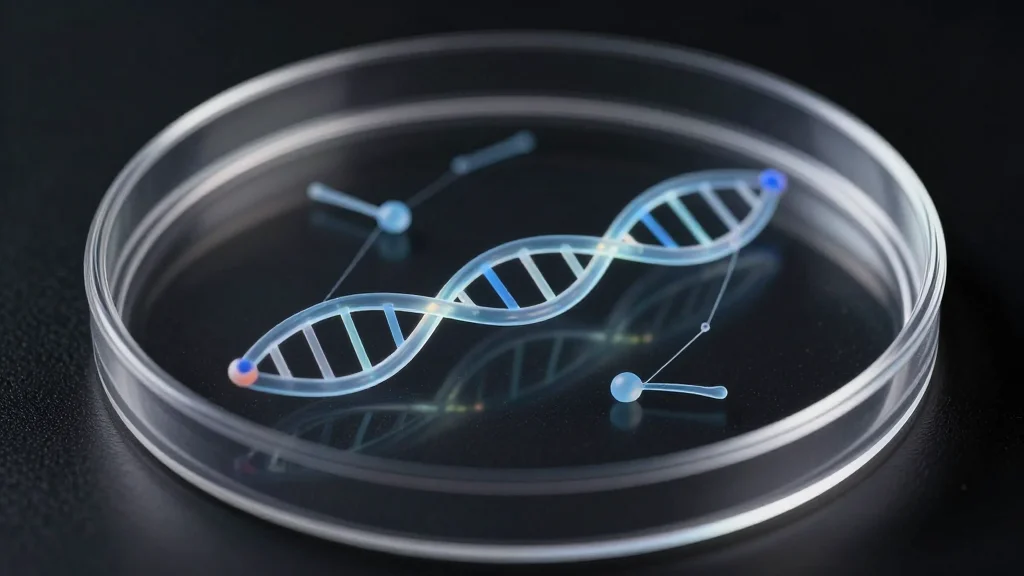
Bottom‐Up Synthesis and Active Assembly of DNA Networks by Biomolecular Nanomachines
Why It Matters
The work demonstrates a practical route to engineer far‑from‑equilibrium materials, unlocking programmable nanofabrication capabilities for advanced biotech and materials applications.
Key Takeaways
- •DNA polymerase synthesizes strands that become network building blocks
- •Kinesin motors actively pull DNA, shaping hierarchical structures
- •Combined chemical and mechanical steps surpass passive self‑assembly limits
- •Network morphology tuned by polymerase time and microtubule density
- •Platform paves way for nanomachine‑driven material fabrication
Pulse Analysis
Active matter—systems that consume energy to maintain order—lies at the heart of biological function, from cytoskeletal dynamics to tissue morphogenesis. Replicating such far‑from‑equilibrium behavior in synthetic materials has long challenged researchers because conventional self‑assembly relies on thermodynamic minima. Biomolecular nanomachines, such as DNA polymerases and motor proteins, offer a route to inject chemical energy and directed motion at the nanoscale, enabling the construction of structures that would otherwise be prohibited by equilibrium constraints.
In the reported study, DNA polymerase continuously elongates nucleic acid strands, providing a supply of polymeric filaments that serve as raw material. Simultaneously, kinesin motors anchored on motile microtubules generate piconewton forces that draw and align these filaments, stitching them into a cohesive 2‑D network. High‑resolution imaging and coarse‑grained simulations reveal that the synergy between strand synthesis and mechanical pulling yields complex, branched morphologies not seen in passive DNA origami. By varying polymerase incubation periods and microtubule densities, the authors map a design space where network density, fiber length, and connectivity can be precisely tuned.
The implications extend beyond academic curiosity. A platform that merges chemical synthesis with active mechanical assembly could accelerate the production of responsive hydrogels, programmable scaffolds for tissue engineering, and nanoscale circuitry that reconfigures on demand. Moreover, the methodology showcases how living‑system principles—energy dissipation, multi‑step processing, and motor‑driven organization—can be harnessed to create next‑generation materials with adaptive, self‑healing, or signal‑responsive properties. As the field moves toward integrating multiple nanomachines, the prospect of fully autonomous, bottom‑up manufacturing pipelines becomes increasingly tangible.
Bottom‐Up Synthesis and Active Assembly of DNA Networks by Biomolecular Nanomachines
Comments
Want to join the conversation?
Loading comments...