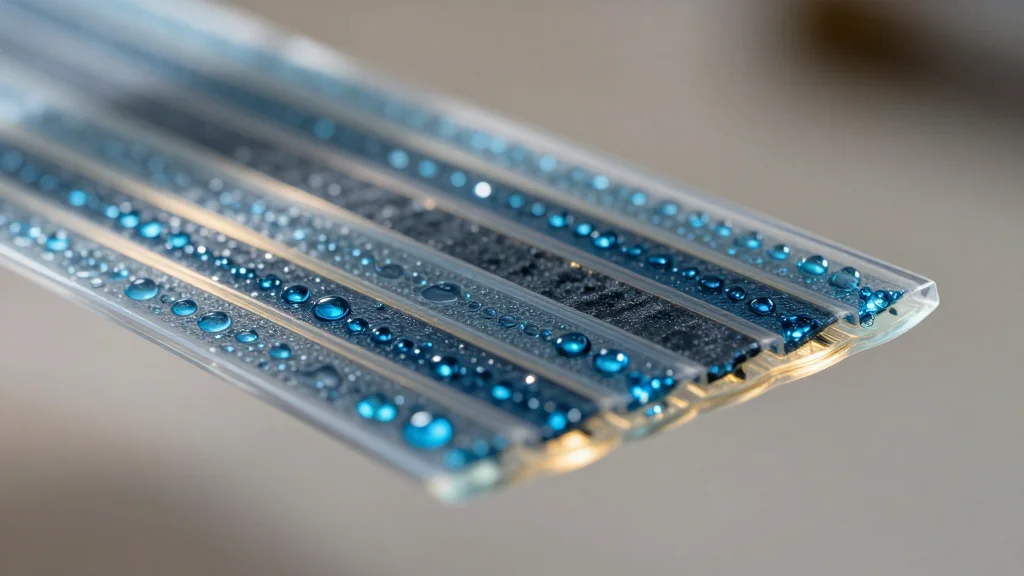
Broad‐Salinity Osmotic Energy Harvesting From Composition Tuned Laminar Membranes
Why It Matters
The breakthrough offers a versatile membrane platform that can harvest blue energy efficiently from diverse water sources, expanding the commercial viability of salinity‑gradient power generation.
Key Takeaways
- •Ti3C2Tx/DAS membranes tuned via DAS fraction for channel size and charge.
- •Low DAS yields narrow, high‑charge channels optimal in high‑salinity RED.
- •High DAS creates larger channels favoring low‑salinity energy extraction.
- •Membrane resistance drives power; electrostatic control high, steric control low salinity.
- •Broad‑salinity performance spans 0.05–5 M, enabling versatile blue‑energy deployment.
Pulse Analysis
Blue energy, harvested from the chemical potential between fresh and salty water, has long been touted as a low‑carbon power source. Yet, practical deployment of reverse electrodialysis (RED) has been hampered by ion‑exchange membranes that excel only within narrow salinity windows. Conventional membranes struggle when feed streams fluctuate, leading to increased resistance and diminished power output. This technical bottleneck has limited RED’s integration with real‑world applications such as coastal wastewater treatment or river‑to‑sea power plants, where salinity can swing dramatically.
The Ti3C2Tx/DAS laminar membranes reported in the recent study address this gap through a materials‑by‑design approach. By adjusting the proportion of 1,4‑phenylenediamine‑2‑sulfonic acid (DAS) within a Ti3C2Tx MXene matrix, researchers simultaneously modulate nano‑channel dimensions and surface charge density. Low DAS content yields tightly spaced, highly charged interlayers that reduce ionic resistance in high‑salinity environments, while high DAS content expands the spacing, facilitating ion transport when concentrations are low. Experimental data show consistent power densities across the full 0.05‑5 M salinity spectrum, confirming that resistance—whether governed by electrostatic or steric effects—is the primary lever for performance.
The implications extend beyond laboratory metrics. A membrane that adapts to fluctuating salinity can be deployed in mixed‑use facilities, pairing desalination brine recovery with river water intake to generate electricity on‑site. Moreover, the tunable platform aligns with scalable manufacturing routes for MXene‑based composites, potentially lowering capital costs. As policymakers seek diversified renewable portfolios, broad‑salinity RED membranes could become a cornerstone technology, driving investment in blue‑energy infrastructure and spurring further research into hybrid membrane‑electrode systems.
Broad‐Salinity Osmotic Energy Harvesting From Composition Tuned Laminar Membranes
Comments
Want to join the conversation?
Loading comments...