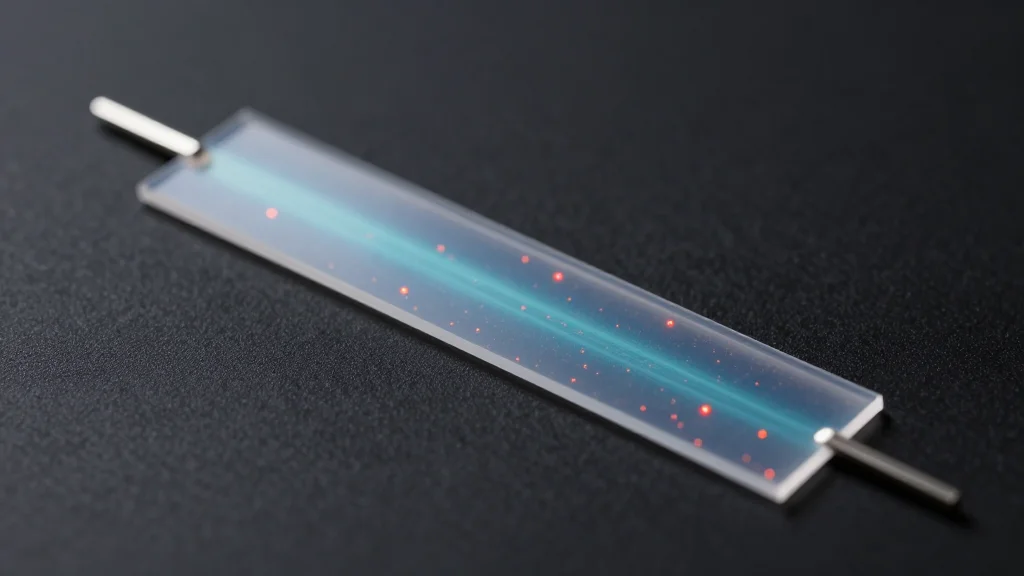
Carbon Dot Composite Mixed Ionic‐Electronic Device Based on Oxygen‐Proton Coupling Catalytic Mechanism
Why It Matters
The device demonstrates a fundamentally new, catalyst‑driven switching paradigm that could improve durability and energy efficiency of neuromorphic chips, accelerating the shift toward brain‑inspired computing architectures.
Key Takeaways
- •CDot-PANI device uses oxygen‑proton coupled catalytic switching.
- •Proton‑assisted ORR accelerates electron transfer, enabling reversible conductance.
- •Demonstrates tunable short‑ and long‑term plasticity mimicking synapses.
- •Provides metal‑free neuromorphic platform, avoiding filamentary degradation.
Pulse Analysis
The emergence of mixed ionic‑electronic devices marks a departure from traditional filament‑based memristors, which often suffer from variability and limited endurance. By embedding carbon dots within a polyaniline matrix, the new CDot‑PANI architecture leverages a proton‑assisted oxygen reduction reaction (ORR) to modulate the polymer’s redox state. This catalytic pathway accelerates electron‑proton transfer, creating localized proton gradients that act as dynamic ionic reservoirs. The result is a highly reversible conductance switch that operates without metal filaments, offering superior structural stability and lower power consumption.
Beyond basic switching, the CDot‑PANI device exhibits a rich repertoire of synaptic behaviors that are essential for neuromorphic computing. Researchers demonstrated tunable short‑term plasticity (STP) and long‑term plasticity (LTP), as well as learning‑forgetting cycles that mimic biological memory consolidation and decay. These functions arise directly from the cascade of oxygen‑proton redox reactions, providing a mechanistic link between electrochemical catalysis and artificial synapse performance. Such capabilities position the technology as a promising candidate for hardware‑level implementation of spiking neural networks and edge‑AI processors.
The broader impact lies in the metal‑free, catalyst‑driven design philosophy. By eliminating reliance on metallic filaments, the CDot‑PANI platform sidesteps common failure modes like filament rupture and electromigration, potentially extending device lifetimes in demanding applications. Moreover, the integrated Poisson‑Nernst‑Planck and Butler‑Volmer modeling offers a predictive framework for scaling the approach to other organic composites. As the semiconductor industry seeks energy‑efficient, brain‑inspired solutions, this oxygen‑proton coupled memristor could become a cornerstone of next‑generation neuromorphic hardware.
Carbon Dot Composite Mixed Ionic‐Electronic Device Based on Oxygen‐Proton Coupling Catalytic Mechanism
Comments
Want to join the conversation?
Loading comments...