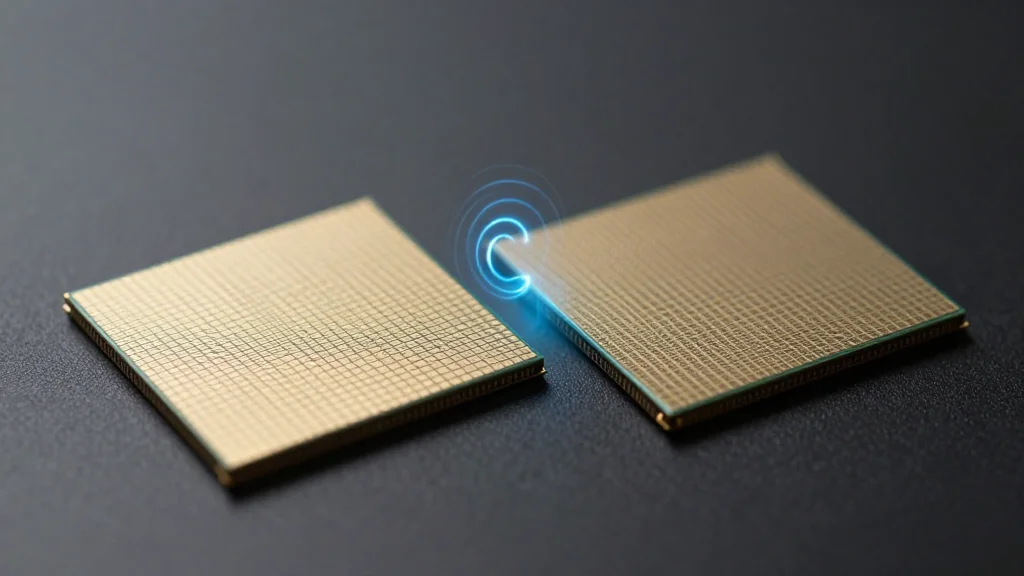
Casimir Forces in Twisted Anisotropic Gratings: A Path to Self-Tuning Nanophotonic Systems
Why It Matters
The discovery turns the Casimir torque from a theoretical curiosity into a practical design tool, allowing nanophotonic devices to self‑align and operate without external control, which could accelerate miniaturized optical technologies.
Key Takeaways
- •Twisted anisotropic gratings reach a stable non‑zero rotation angle via Casimir torque
- •Equilibrium angle is independent of gap distance, enabling self‑assembly
- •Material anisotropy determines torque magnitude, offering design freedom for nanophotonics
- •Potential uses include actuator‑free optical switches, sensors, and quantum circuits
Pulse Analysis
The Casimir effect, long regarded as a subtle quantum force between neutral bodies, has found a new engineering foothold in nanophotonics. By arranging two one‑dimensional photonic gratings with anisotropic dielectrics at a twist, researchers broke mirror symmetry and introduced in‑plane chirality. This geometric nuance reshapes the Casimir‑Lifshitz interaction, producing a torque that drives the gratings toward a specific angular offset. Crucially, the equilibrium angle emerges from the intrinsic anisotropy of the material rather than the separation distance, meaning that once the structures are brought close, they automatically settle into the optimal orientation.
From a device‑design perspective, this self‑tuning mechanism eliminates the need for external actuators or feedback loops to achieve precise alignment. Optical switches, ultra‑compact sensors, and quantum‑optical circuits often demand sub‑nanometer positioning accuracy, which is difficult to maintain mechanically at scale. The Casimir‑driven torque offers a passive, energy‑free solution that can be programmed through material choice, opening a pathway to robust, low‑power nanophotonic architectures. Moreover, because the torque magnitude scales with the dielectric anisotropy, engineers can tailor the response by selecting or engineering materials with optimal birefringence.
Looking ahead, the next research frontier involves identifying high‑anisotropy dielectrics that maximize torque while minimizing losses, as well as integrating these chiral gratings into existing photonic platforms. If successful, the approach could underpin a new class of reconfigurable metasurfaces that adapt their optical response on demand, fostering advances in adaptive optics, secure communications, and on‑chip quantum information processing. The convergence of quantum vacuum forces and material engineering thus promises to reshape how nanophotonic systems are built and controlled.
Casimir forces in twisted anisotropic gratings: A path to self-tuning nanophotonic systems
Comments
Want to join the conversation?
Loading comments...