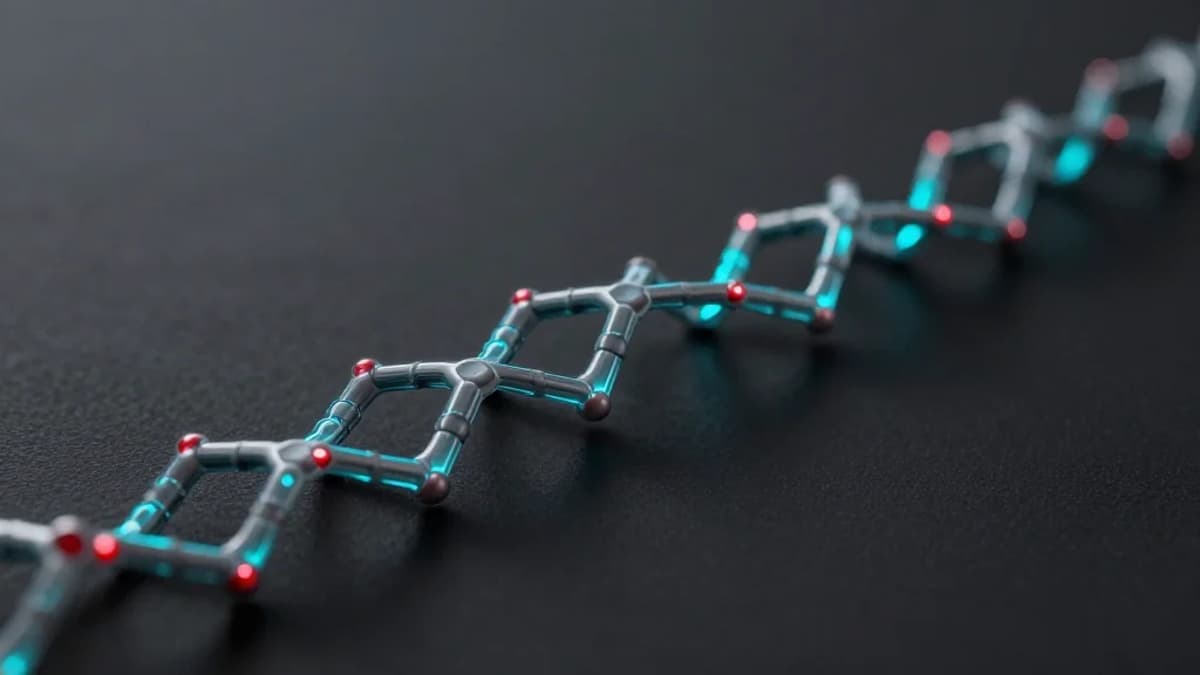
Chemically Tuning Nanographene Into Topological Spin Chains and Why the Ends Matter
•March 5, 2026
0
Why It Matters
The ability to program topological edge spins via molecular design offers a scalable, symmetry‑protected platform for future spin‑qubit architectures, bridging chemistry and quantum information science.
Key Takeaways
- •Nanographene monomers can form programmable 1D magnetic polymers.
- •Same scaffold yields dimerized S=½ and S=1 Haldane phases.
- •Edge states emerge from bulk topology, offering protected spins.
- •Simulations confirm bulk gap and termination‑dependent edge signatures.
- •Chemistry provides a tunable platform for future spin‑qubit devices.
Pulse Analysis
The study leverages nanographene’s intrinsic flexibility to create a modular building block that can be stitched into a linear polymer on a substrate. By functionalizing the monomer’s edges, chemists control the distribution of unpaired electrons, dictating the magnetic moment on each repeat unit. First‑principles calculations map the orbital overlap and predict exchange couplings, while many‑body techniques translate these parameters into effective spin models, establishing a reliable computational pipeline for designing low‑dimensional quantum magnets.
Two topologically distinct phases emerge from the same chemical scaffold. In the first, a single unpaired electron per monomer yields an alternating strong‑weak exchange pattern, analogous to the Su‑Schrieffer‑Heeger model, which opens a bulk gap and leaves unpaired edge spins. The second phase exploits Hund’s rule: two electrons on a monomer align to form an effective spin‑1 site, coupling antiferromagnetically into a Haldane chain that hosts fractionalized spin‑½ edge states despite uniform bonds. Both configurations exhibit symmetry‑protected edge modes that persist as long as the bulk gap remains open.
From a technology perspective, these edge spins act as naturally localized quantum bits that can be accessed with scanning‑probe techniques, offering a tangible route toward molecular spin‑qubit devices. Their topological protection mitigates the impact of moderate disorder, a critical advantage over conventional qubit platforms. The chemistry‑first approach flips the traditional discovery paradigm, allowing researchers to target desired topological properties and synthesize the requisite molecules. Upcoming experimental work will focus on assembling the chains on conductive surfaces, verifying magnetic signatures with STM/STS, and exploring coherent control of the edge states, potentially linking molecular synthesis, surface science, and quantum information in a single workflow.
Chemically tuning nanographene into topological spin chains and why the ends matter
0
Comments
Want to join the conversation?
Loading comments...