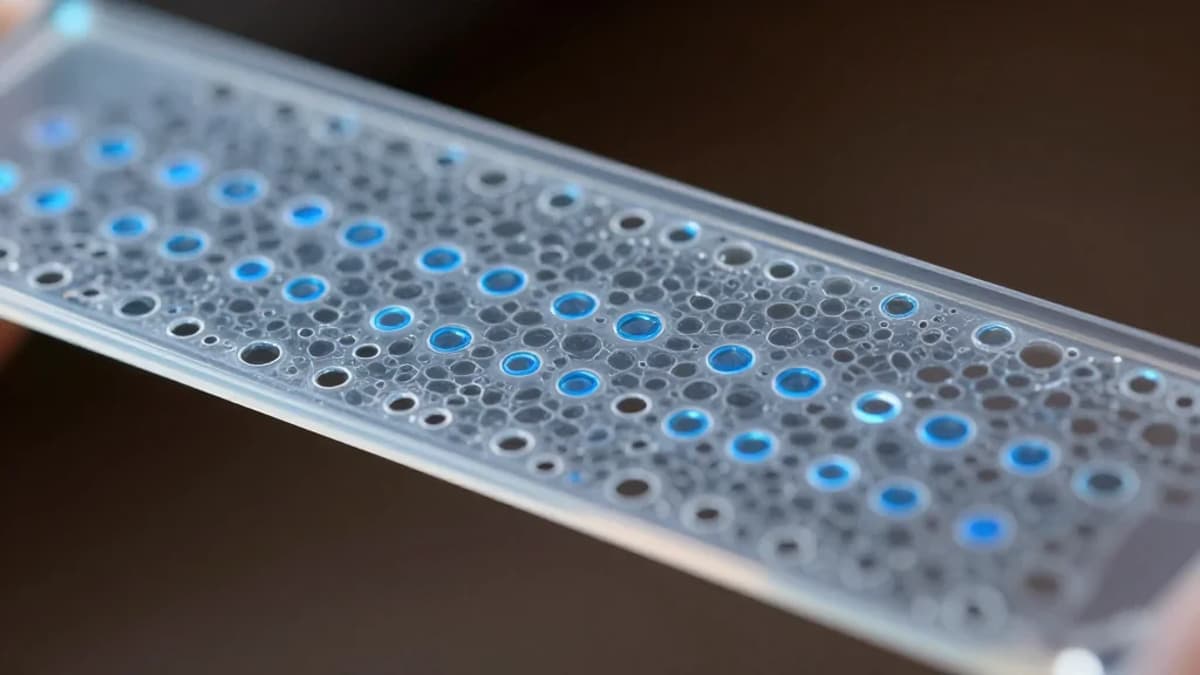
Chemistry-Powered 'Breathing' Membrane Opens and Closes Tiny Pores on Its Own
•February 18, 2026
0
Why It Matters
It delivers a reproducible, voltage‑controlled platform that replicates ion‑channel dynamics, unlocking new capabilities for nanoscale analytics and brain‑inspired hardware.
Key Takeaways
- •Voltage switches precipitate, opening/closing subnanometer pores.
- •Process repeats hundreds of cycles with stable performance.
- •Pore size tunable via solution composition and pH.
- •Enables selective ion transport mimicking biological channels.
- •Potential for DNA sequencing, neuromorphic chips, nanoreactors.
Pulse Analysis
The ability to fabricate pores that approach the angstrom scale has long been a bottleneck in nanofluidics, limiting the fidelity of solid‑state analogs to biological ion channels. Osaka’s approach sidesteps traditional lithographic constraints by turning the nanopore itself into a miniature electrochemical reactor. When a negative bias is applied, metal ions precipitate inside the pore, sealing it; a reverse bias dissolves the deposit, restoring conductivity. This reversible chemistry mimics the conformational gating of protein channels while offering the robustness of inorganic materials.
Beyond the basic open‑close cycle, the researchers demonstrated precise control over pore geometry through solution chemistry. By tweaking pH and ionic species, they could shrink or expand the effective aperture, producing distinct ion‑current spikes that resemble the stochastic behavior observed in neuronal membranes. Such tunability not only validates the system as a model for studying confined ion transport but also provides a practical knob for tailoring selectivity toward specific ions or molecules, a feature critical for high‑resolution sensing platforms.
The broader impact lies in translating this biomimetic functionality into commercial technologies. In DNA sequencing, subnanometer pores could improve base‑calling accuracy by enhancing signal‑to‑noise ratios. Neuromorphic circuits could exploit the voltage‑induced spikes to emulate neuronal firing without complex semiconductor architectures. Moreover, the confined environment of a dynamically gated nanopore serves as a nanoreactor, enabling unique reaction pathways inaccessible in bulk. As the field moves toward integrating such membranes into chips, the Osaka breakthrough positions chemistry‑driven nanopores as a versatile foundation for next‑generation analytical and computing devices.
Chemistry-powered 'breathing' membrane opens and closes tiny pores on its own
0
Comments
Want to join the conversation?
Loading comments...