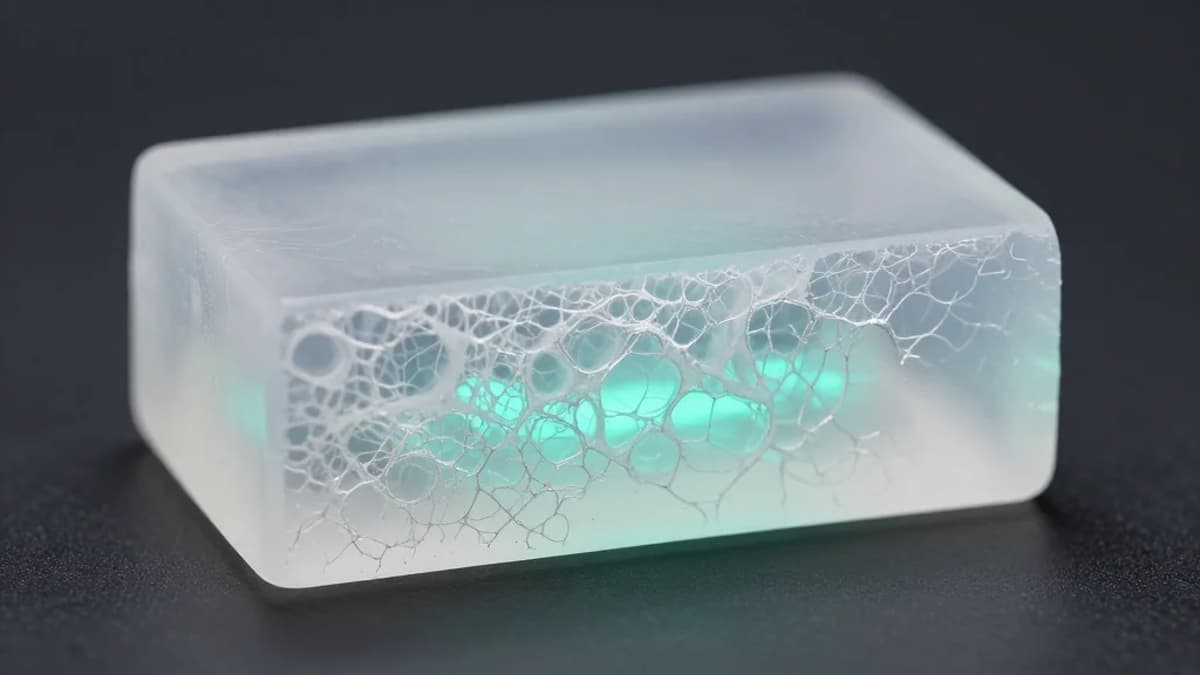
Designing Stable Graphitic Networks on Ultra‐Porous Polyimide Aerogels via Solvent‐Guided Structuring
•January 27, 2026
0
Companies Mentioned

Why It Matters
Embedding conductive graphene in a lightweight, thermally stable aerogel unlocks durable flexible electronics, high‑frequency antennas, and efficient thermal‑management solutions, overcoming performance limits of conventional polymer devices.
Key Takeaways
- •Solvent‑guided structuring yields thermally robust PI aerogel.
- •Laser‑induced graphitization produces uniform graphene network.
- •Sheet resistivity reaches 6.5 Ω sq⁻¹ with low dielectric loss.
- •Thermal conductivity stays below 35 mW m⁻¹ K⁻¹ after 300 °C.
- •Flexible sensors and ultralight antenna show high gain.
Pulse Analysis
Polyimide aerogels have attracted attention for aerospace and electronics because their open‑cell architecture delivers extreme lightness while withstanding temperatures above 400 °C. Yet, converting such porous polymers into conductive carbon structures using laser‑induced graphitization has been hampered by rapid heat localization, which often collapses the delicate framework. The recent study solves this bottleneck by deliberately adjusting solvent‑polymer affinity during gelation, creating a hierarchical pore network that dissipates heat and preserves mechanical integrity. This molecular‑level control transforms the aerogel into a reliable platform for in‑situ graphene formation.
The resulting graphene‑infused aerogel exhibits a sheet resistivity of just 6.5 Ω sq⁻¹, rivaling thin‑film metal conductors, while its relative permittivity remains between 1 and 2 with a loss tangent below 0.2. Such electrical characteristics are achieved without compromising thermal performance; the composite maintains a conductivity of 30–35 mW m⁻¹ K⁻¹ even after exposure to 300 °C, indicating robust insulation. This rare combination of high conductivity, low dielectric loss, and thermal stability positions the material as a strong candidate for next‑generation flexible circuits and high‑frequency components.
Prototype demonstrations include a flexible pressure sensor that leverages the conductive network for real‑time force mapping, and an ultralight antenna delivering a −14 dB reflection coefficient at 5.4 GHz with a peak gain of 3.9 dBi. These results illustrate how the technology can shrink device footprints while enhancing durability, a critical advantage for wearable electronics, unmanned aerial vehicles, and satellite payloads. As industries push for ever lighter, more resilient components, solvent‑guided structuring of polyimide aerogels is likely to inspire further research into scalable manufacturing and integration with existing roll‑to‑roll processes.
Designing Stable Graphitic Networks on Ultra‐Porous Polyimide Aerogels via Solvent‐Guided Structuring
0
Comments
Want to join the conversation?
Loading comments...